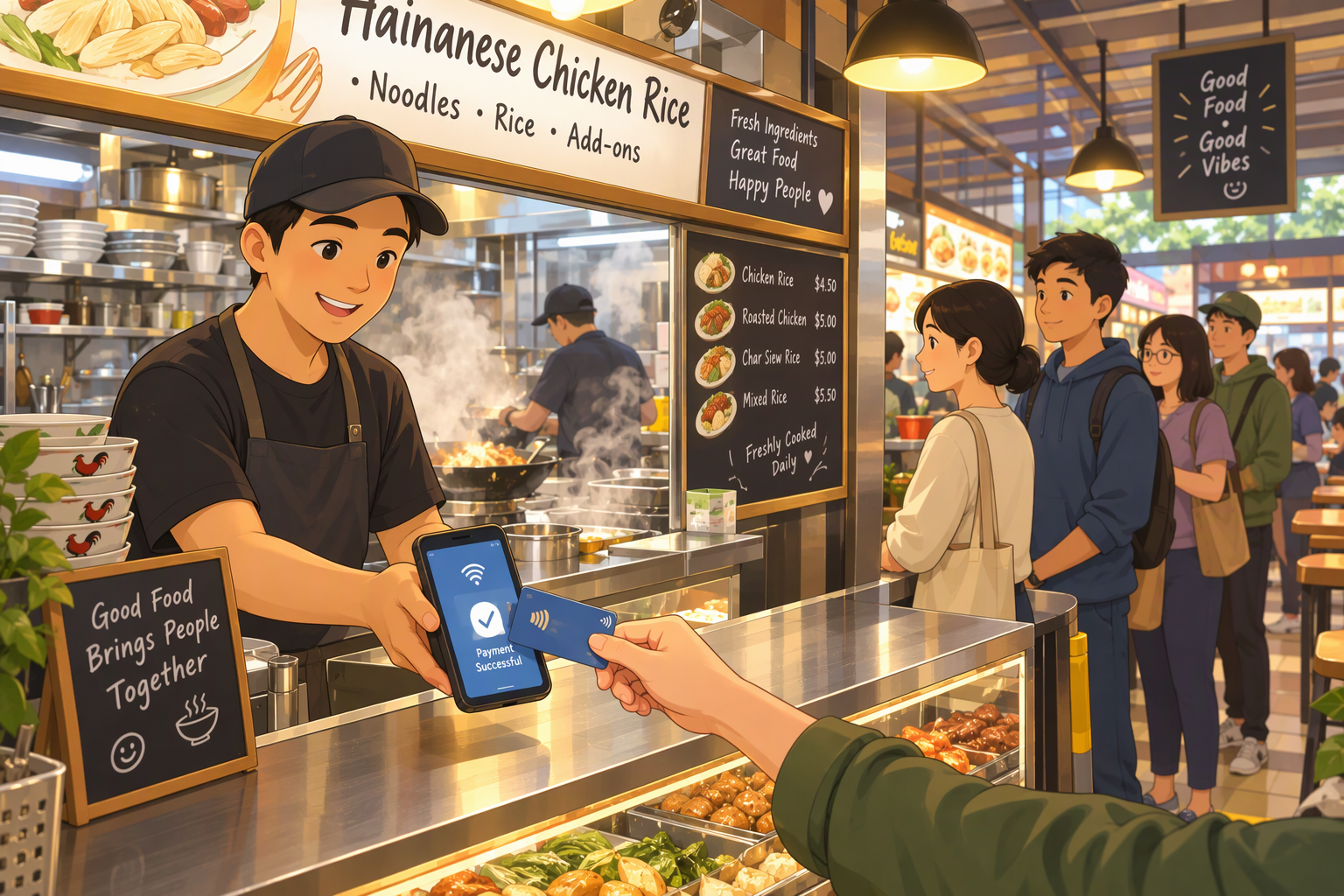
At a busy hawker stall, every step in a payment matters. If a customer has to unlock a phone, open an app, scan a QR code, enter an amount and confirm, the queue may have to wait. Could a simple tap make things easier?
That is the possibility explored by Daniel Rabetti, an assistant professor at NUS Business School, in an article about Apple’s Tap to Pay on iPhone. Apple launched the feature in Singapore in December 2025. It lets a merchant with a compatible iPhone and a partner-enabled app enter the payment amount. The customer can then tap a contactless credit or debit card, or a mobile wallet such as Apple Pay, on the merchant’s phone.
The appeal is easy to picture: fewer steps at the counter could mean a quicker exchange. Rabetti suggests that faster transactions may be useful for businesses serving many customers, such as hawker stalls, where keeping a queue moving is important. The phone also takes the place of a separate payment terminal, potentially freeing up counter space. During a busy stretch of cooking and serving, not having to handle an extra device could be convenient too.
But these are potential advantages, not proven results for Singapore hawkers. The article does not show that Tap to Pay has already shortened queues at local stalls, improved hygiene or lowered merchants’ overall payment costs. It also does not say how many Singapore hawkers use the feature. So the idea is promising, but its real-world effect at hawker centres remains an open question.
There is also a bigger picture to consider. Hawkers already have a range of ways to accept digital payments, including QR codes, PayNow, NETS, e-wallets and, at some stalls, card terminals. Each system may come with its own app, settlement schedule and reporting format. Adding another option might make payment easier for some customers while giving merchants more administrative work to manage afterwards.
The feature also has a hardware requirement: merchants need an iPhone XS or later, as well as a partner-enabled app. That means it may not be available to every stall without the right device and setup.
Tap to Pay offers a different way to handle a familiar moment: paying for lunch. Its promise is speed and a simpler counter setup; its challenge is fitting neatly into the collection of payment systems hawkers already use. Whether that balance works for Singapore stalls will depend on merchants’ experience—not just on how quick a tap looks.
Source: Could Apple’s Tap to Pay be a game changer for hawkers?, NUS BizBeat
Leave a Reply