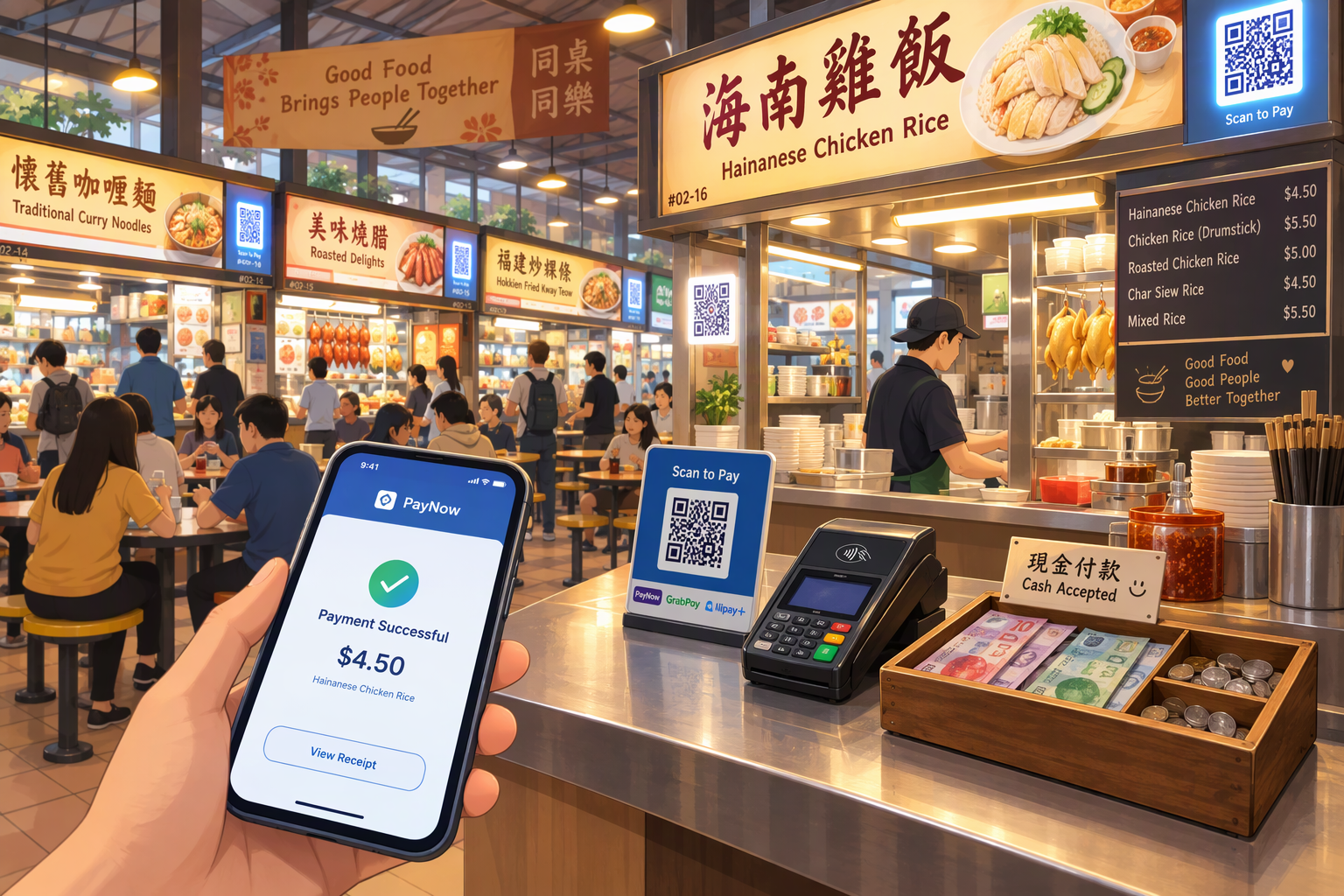
At Tanjong Pagar Plaza Market and Food Centre, a customer could pay for a meal by scanning a QR code instead of reaching for cash. The system offered a glimpse of another way to settle a hawker-centre bill—but its arrival also raised a practical question: would diners and stallholders find it useful if cash remained their habit?
The centre was described in the article as Singapore’s first hawker centre to introduce QR-code payments. At the time of reporting, almost every stall displayed a QR code, and NETS had recently rolled out a standardised code there. Customers could scan the code with a banking app, enter the amount and wait for confirmation when the stall’s terminal printed a receipt. That terminal also accepted NETS and NETS FlashPay.
For the centre’s association chairman, Benson Low, the aim was to give customers more choices. He encouraged hawkers to take part so diners could choose how to pay. A QR code could offer an alternative to cash, while the terminal brought several payment methods together at the stall.
But adding an option did not mean everyone was ready to use it. Cash remained the preferred choice among the customers interviewed. Low estimated that 95 per cent of customers at his own stall paid in cash; other stallholders interviewed reported similar figures. That number was his estimate for his stall, not a survey of hawker-centre customers across Singapore.
The diners’ comments show why a new payment method might not suit everyone straight away. Tay Ching Ching said her phone did not support the technology and that she found cash more convenient. Another diner, identified as Mr Koh, thought the cashless options were good and easy to set up, but said he was not accustomed to using them and paid with cash.
There was also a broader standardisation effort in the picture. The article mentions a taskforce called SGQR, which aimed to establish standardised QR specifications that could accept domestic and international payment schemes by the end of 2017. The brief does not establish whether that aim was achieved, or what the longer-term effects of the rollout were.
The scene at Tanjong Pagar Plaza captures both sides of trying a new payment system: it can widen the choices available, but its presence alone does not make it the preferred choice. The article’s examples are specific to this centre and the people interviewed. For those hawkers and diners, the QR code opened a new route to payment—while cash still had a firm place at the counter.
Source: Going cashless at hawker centres: Challenges and opportunities, CNA Lifestyle
Leave a Reply