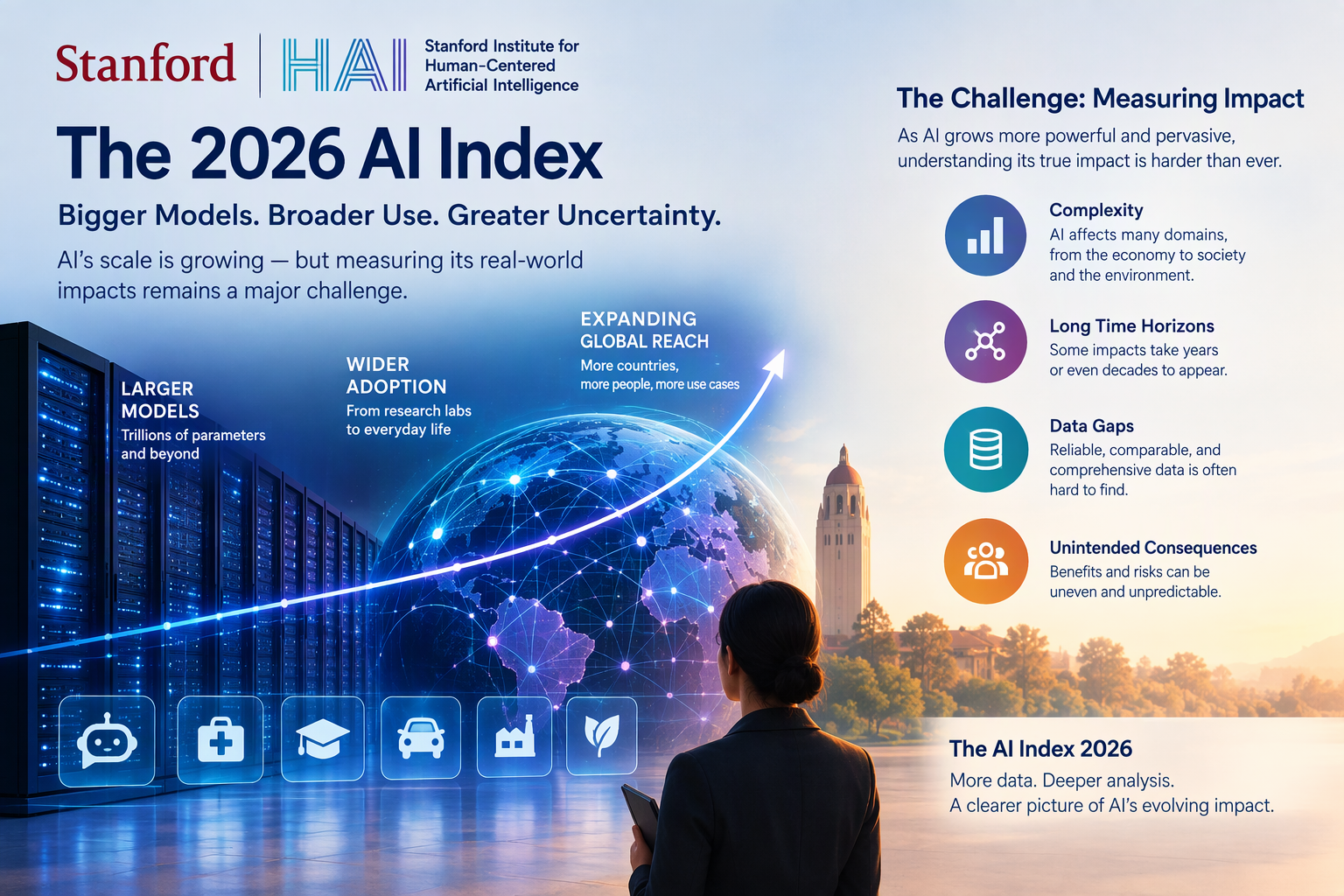
Artificial intelligence is advancing at remarkable speed—but the latest AI Index points to a growing challenge: keeping track of its costs and consequences. Stanford HAI’s 2026 report surveys changes in AI since the Index began in 2017, from technical capabilities and research to social impacts and public opinion. Its message is not simply that AI is getting more powerful. It is that society’s ability to measure and manage that progress is moving more slowly.
Some of the report’s most striking figures concern the resources behind AI. Training Grok 4 was estimated to produce 72,816 tons of carbon-dioxide equivalent—compared in the article with the emissions from driving 17,000 cars for a year. AI data-centre power capacity reached 29.6 gigawatts. The article also says annual water use associated with GPT-4o inference may exceed the drinking-water needs of 1.2 million people. That estimate includes water used for data-centre cooling or associated with hydroelectric power. The cumulative electricity demand of AI systems, the article notes, compares with the national electricity consumption of Switzerland or Austria.
These comparisons make an invisible part of using AI easier to picture: behind a prompt or generated answer are data centres that need power and water. The article gives headline estimates, but the material summarized here does not provide the detailed methods or assumptions behind them. They are useful signals of scale, not a complete account of every system’s footprint.
The report also describes an increasingly close race between the United States and China. Since early 2025, models from the two countries have repeatedly traded places near the top of performance rankings. DeepSeek-R1 briefly matched the leading US model in February 2025. By March 2026, Anthropic’s top model led by 2.7%.
There is no single winner across the field. The United States produces more top-tier models and higher-impact patents, while China leads in AI publication volume, citations, patent output and industrial-robot installations. The different measures show why a simple ranking can miss important parts of the competition.
Meanwhile, the effects are not limited to laboratories or international scoreboards. The article flags workforce disruption as a current concern and says young workers are being affected first. It does not quantify the impact or establish that AI alone caused changes in employment, so the finding is a warning to pay attention—not a complete explanation of what is happening. The report also says the United States spends more on AI than any other country but is finding it harder to attract top talent; it does not explain why.
Taken together, the findings leave readers with a question larger than who builds the strongest model: how can the benefits of rapid progress be shared while its resource demands and social effects are understood and managed? AI may open new possibilities in science and complex reasoning, but progress also calls for careful measurement, transparency and oversight. The Index offers a snapshot of a fast-changing field—and a reminder that keeping up involves more than building the next system.
Source: Inside the AI Index: 12 Takeaways from the 2026 Report, Stanford Institute for Human-Centered Artificial Intelligence (Stanford HAI)
Leave a Reply