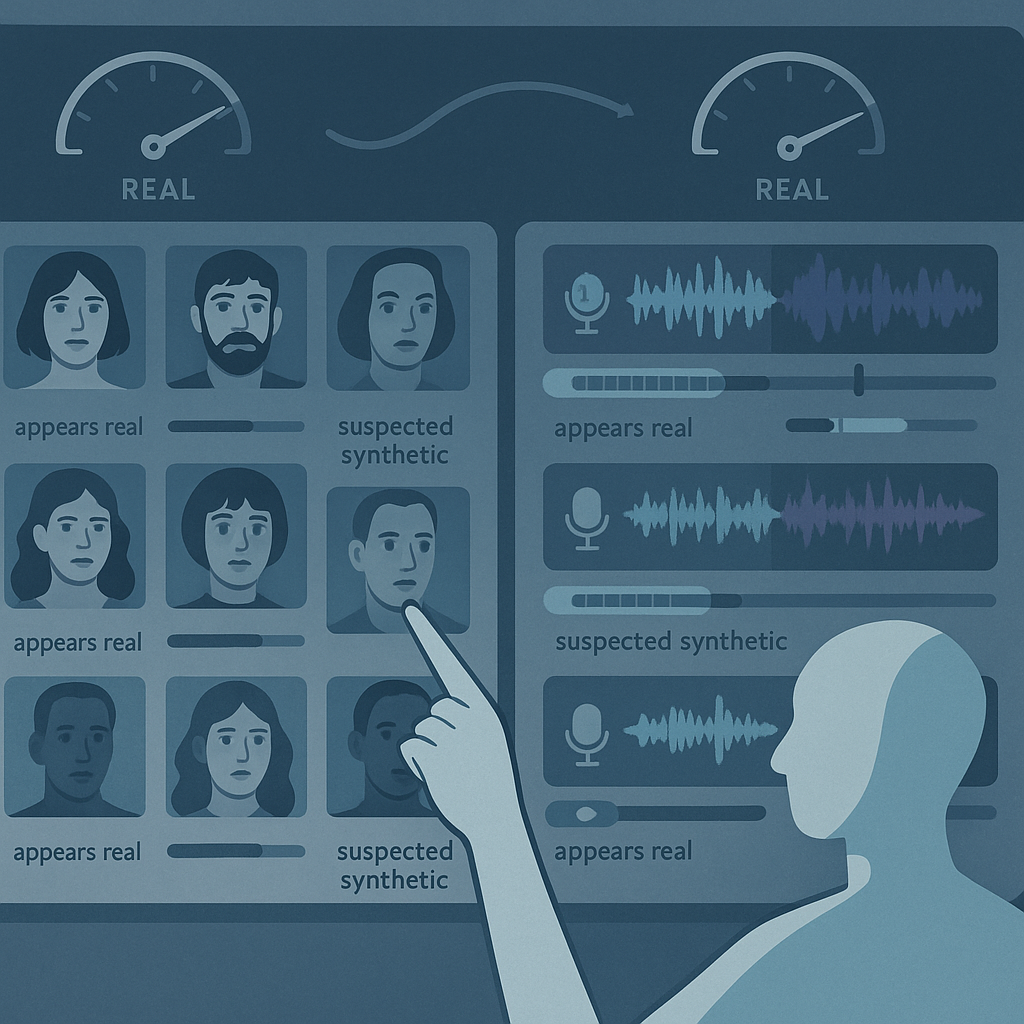
Generative AI can now create eerily convincing faces and voices, but a new pre-registered study in Scientific Reports (Ivory et al., 2026) suggests there isn’t a single human skill for spotting synthetic social signals. The paper asks a simple, practical question: do people who are good at detecting AI‑made faces also spot AI‑made voices — in other words, is there a modality‑general “realness detector”? The answer from this controlled experiment is: no.
How the study was done
The authors ran a within‑participant experiment online (PsychoJS/Pavlovia) with participants recruited from Prolific (eligibility: English fluency, normal/ corrected vision and hearing, age 18–30). After exclusions the analytic sample was 172 participants (mean age ≈24.9 years). Participants completed both a face classification task and a voice classification task; order was counterbalanced and each task began with labelled training examples and attention checks.
Stimuli were tightly controlled. The face set contained 40 static images (20 real faces from the Flickr‑Faces‑HQ dataset, 20 synthetic faces produced with Adobe Firefly), balanced for gender and ethnicity. The voice set used 40 real speakers from the VCTK database reading the Rainbow Passage and 40 cloned voices produced with an Instant Voice Cloning tool (ElevenLabs); voice clips were duration‑matched to the faces (average display ~2.75 s) and counterbalanced so participants never heard a real speaker and their clone in the same session.
Key findings
– Above chance but not transferrable: Participants performed above chance at distinguishing real from synthetic in both modalities, yet performance on faces did not predict performance on voices. The authors report no evidence of a domain‑general detection ability — being good at spotting facial deepfakes doesn’t mean you’ll be good at spotting voice clones.
– Truth‑default bias: Across the board participants showed a bias toward judging items as real (a “truth‑default”). This liberal bias was substantially stronger for faces than for voices (reported effect sizes: D = −0.60 for faces vs D = −0.22 for voices).
– Modality differences in sensitivity and metacognition: Faces were easier to classify correctly than voices (modality predicted d′ with β = −0.115, t = −3.99, p < .001). Confidence tracked accuracy for faces but not for voices, suggesting people had better metacognitive insight when judging faces than when judging voice samples.
– Cues that matter (and don’t): For faces, perceptual attributes such as perceived skin smoothness were associated with judgments of “synthetic” and predicted greater accuracy. For voices, perceived distinctiveness in this stimulus set did not differ reliably between real and synthetic samples. Objective embedding‑based measures of distinctiveness (ArcFace for faces, SpeechBrain ECAPA‑TDNN for voices) were used to characterize stimuli, but distinctiveness itself did not straightforwardly predict who would classify items correctly.
What the results mean in practice
The absence of a single, transferable “deepfake‑spotting” skill has practical consequences. Training people to detect synthetic content is unlikely to generalize across modalities: law‑enforcement officers, moderators, or journalists may need modality‑specific training and tools (face‑focused methods for images/video, separate voice‑analysis tools for audio). The authors highlight that as generative models improve, human detection will probably become less reliable, strengthening the case for algorithmic detection, procedural safeguards, and institutional policies rather than sole reliance on unaided human judgement.
Limitations and important caveats
Ivory et al. are careful to bound their claims. The experiment primed participants by telling them some stimuli could be synthetic and presented items under controlled, brief exposures — conditions that differ from real‑world encounters where people often aren’t suspicious and can assess dynamic or contextual cues. The participant pool was restricted to 18–30‑year‑olds recruited online, so results may not generalize to other ages, cultures, or expert populations (forensic analysts, audio engineers). The study used specific generative tools (Adobe Firefly for faces and ElevenLabs for voice cloning) and static images/short audio clips; advancing models, multimodal video, or conversational contexts could produce different outcomes.
Bottom line
This controlled study shows humans can do better than chance at spotting current synthetic faces and voices, but the ability is modality‑specific: being skilled in one modality doesn’t predict skill in the other. That challenges the idea of a single, catch‑all “spot the deepfake” competence and underscores the need for targeted training, robust detection tools, and cautious policies. As the authors warn, these findings are tied to the stimuli, tools, and participant group used — and the generative landscape is evolving fast.
Full citation
Ivory, M., McGettigan, C., Nuttall, H. E., Nightingale, S. J., et al. Human detection of AI‑generated faces and voices is not domain‑general. Scientific Reports 16, 28639 (2026). DOI: 10.1038/s41598-026-59364-3.
Leave a Reply