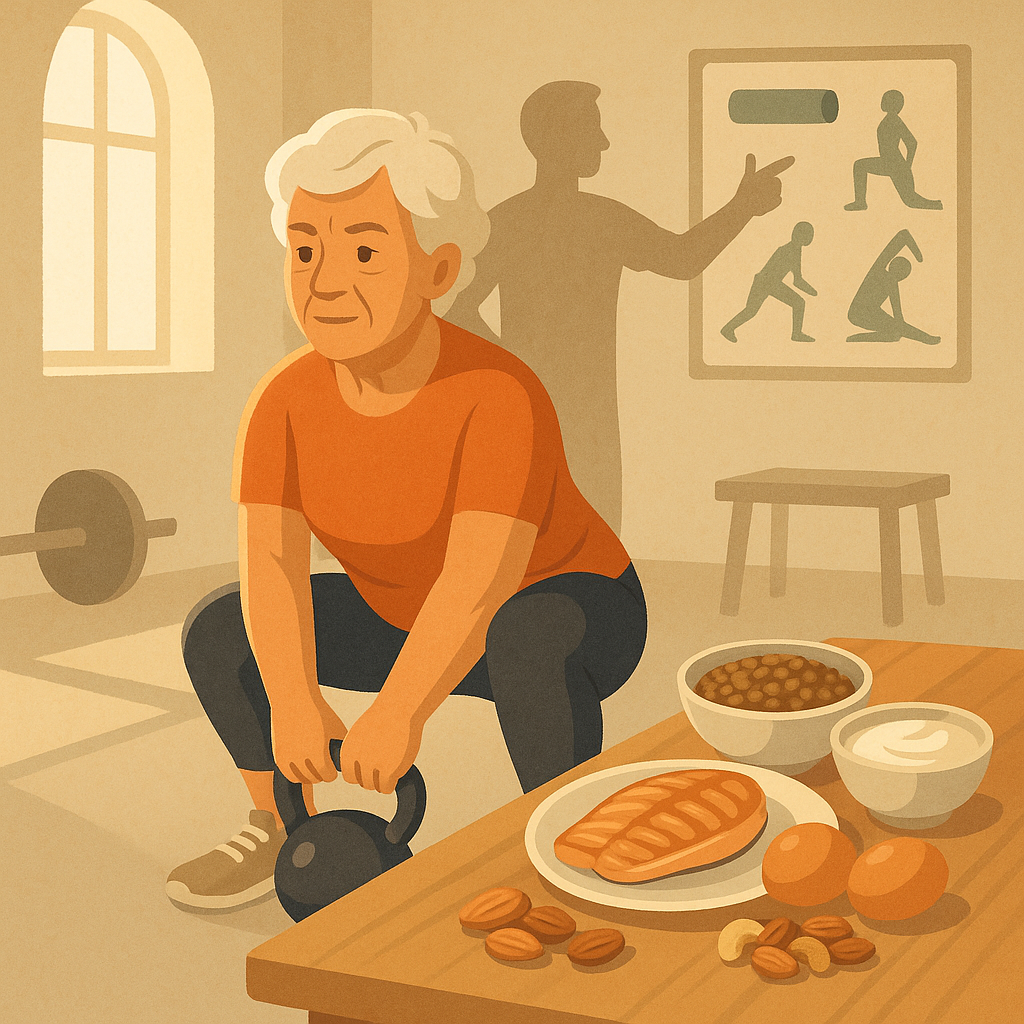
If you want stronger muscles that help you move better, carry more, and feel more energetic as you age, the most reliable tool available is also the most underrated: resistance (weight) training. A recent Harvard Health Publishing write‑up lays out a clear, evidence‑backed approach for building and preserving muscle using training, whole foods, and sensible recovery—without relying on fancy supplements. Here’s a practical, natural plan that follows those recommendations.
Why resistance training matters
Resistance training is the primary, evidence‑backed strategy for slowing age‑related muscle loss and increasing muscle mass. It isn’t about getting huge; it’s about maintaining strength and function so everyday tasks—like standing up from a chair, climbing stairs, or carrying groceries—stay easier for longer. The safest, most effective forms of resistance training use progressive loading and compound movements that mirror real life.
How to train: the essentials
– Choose the right tools. Free weights (dumbbells, kettlebells, barbells) are often preferable because they recruit stabilizer muscles and allow compound movements that build functional strength. Machines can still be useful—especially if balance, mobility, or safety concerns make free weights impractical.
– Focus on compound exercises. Movements that work multiple muscle groups at once—squats, deadlifts, lunges, and similar patterns—offer the most bang for your time, especially for leg strength and tasks you do daily.
– Reps, sets, and tempo. For older adults and many beginners, a useful target is about eight repetitions per exercise and three sets. Use a controlled tempo—around seven seconds per rep (3 seconds lifting, 1 second pause, 3 seconds lowering)—so muscles stay under tension throughout the movement.
– Progressive overload. Aim to use enough weight that the last few reps of each set are challenging. When you can complete eight reps comfortably without fatigue, increase the weight. Muscles grow only when the resistance is increased over time.
– Frequency and recovery. Two full‑body weight sessions per week are sufficient to produce measurable changes for many people. Always allow at least 48 hours between sessions so muscles can recover. With consistent effort, many people start to feel results in roughly 4–6 weeks.
Special emphasis for older adults
Leg strength deserves particular attention—quads, hamstrings, glutes, and calves are critical for balance and functional movements like squatting and stair climbing. For strength gains, fewer reps with heavier weights can be more effective, but lighter weights with higher reps are an acceptable option if movement issues or pain limit heavier lifting. If balance or mobility is a concern, machines or modified movements can still build meaningful strength safely.
Nutrition—build muscle with whole foods
If training is the engine for muscle growth, dietary protein is the fuel. While sedentary adults generally need about 0.8 g/kg of body weight per day, the article recommends increasing protein intake by roughly 50%—to about 1.2 g/kg per day—when the goal is to build muscle. As a concrete example, a 175‑lb (≈79 kg) man should aim for about 95 g of protein daily.
Practical protein tips from whole foods
– Divide protein across meals rather than concentrating it in one sitting. Aim to spread intake roughly equally across the day.
– After workouts, eat about 20–40 g of protein within an hour to support muscle repair.
– Prefer whole‑food sources. Examples and approximate protein amounts given in the article include: 3 oz lean chicken (24 g); 8 oz plain Greek yogurt (23 g); 1 cup cooked lentils (18 g); 3 oz salmon (17 g); 2 eggs (13 g); 1 oz (28 g) peanuts (7 g). These are straightforward ways to hit daily targets without relying on powders or pills.
– Protein powders (whey or plant‑based) are noted as an easy option to meet targets if needed, but the emphasis here is on whole foods.
Safety and practical coaching
Learning proper form and technique matters. The article recommends investing in a licensed or credentialed trainer—either in person or via virtual coaching—to learn safe movement patterns and a personalized program. If you have mobility or balance limitations, use machines or tailor exercises (lighter weights, higher reps, or split routines that separate upper and lower body work) to reduce injury risk while still gaining strength. Rest and recovery are non‑negotiable: they prevent overuse injuries and allow the muscle‑building process to happen.
What to expect—and what the guidance doesn’t provide
Two days per week of consistent resistance training can produce measurable changes, and many people notice improvements in 4–6 weeks. However, the source does not offer a detailed week‑by‑week beginner program, exact exercise progressions, or sample sessions. It also doesn’t prescribe specific calorie or macronutrient targets beyond the protein recommendation, nor does it provide sex‑specific or clinical population guidance (for example, pregnancy or certain chronic diseases). Advanced hypertrophy tactics (periodization models, blood‑flow restriction, cluster sets) and a deep evaluation of supplement safety and regulation are beyond its scope.
Putting it together: a simple, natural plan
– Train: Two full‑body resistance sessions per week using primarily free weights and compound lifts (squats, deadlifts, lunges, presses, rows), 3 sets of ~8 reps, controlled 3–1–3 tempo. Increase weight when eight reps become comfortable.
– Fuel: Aim for ~1.2 g/kg protein per day, spread evenly across meals, and include 20–40 g of protein within an hour after training. Favor whole‑food sources such as chicken, Greek yogurt, lentils, salmon, eggs, and nuts.
– Recover: Rest at least 48 hours between sessions, prioritize sleep and mobility work, and get professional instruction if new to lifting or managing limitations.
If you want a publish‑ready starter program or meal plan built strictly from these recommendations (for example, a twice‑weekly workout template plus a day‑by‑day protein‑distribution meal guide using only the whole‑food examples above), I can create that next—staying strictly within the facts in the Harvard Health article.
Leave a Reply