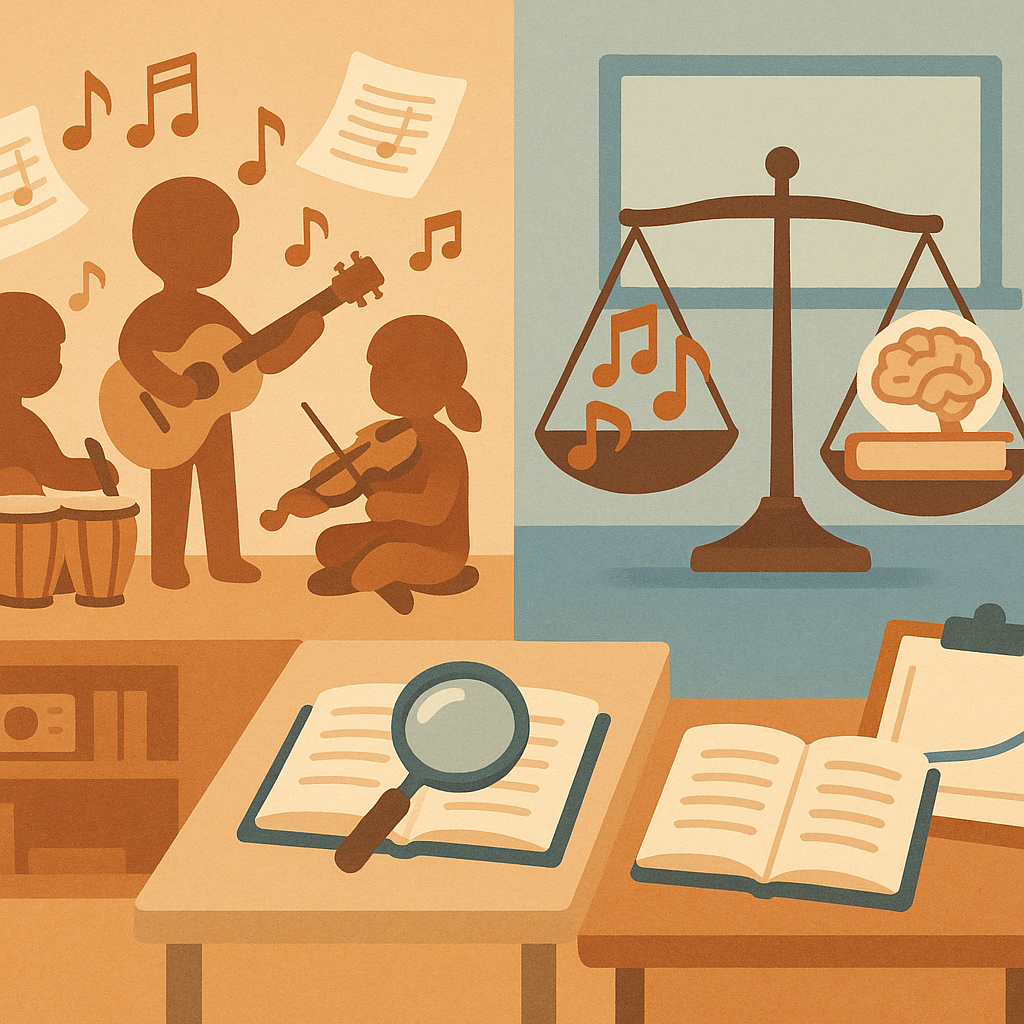
Music training is widely promoted as a way to boost children’s brains, school performance and general intelligence. But a large, careful synthesis of the experimental evidence—published in Memory & Cognition by Giovanni Sala and Fernand Gobet—shows this claim doesn’t hold up as a broad, causal effect.
What the authors did
Sala and Gobet ran a systematic, multilevel meta‑analysis of experimental studies of music‑training programs for children. Their dataset included 54 eligible studies, 254 effect sizes, and 6,984 participants; the literature search covered work published through December 1, 2019 (the article itself was published July 29, 2020). The analysis focused on cognitive and academic outcomes outside of music (for example, verbal and non‑verbal cognition, processing speed, literacy and mathematics).
The headline finding
After accounting for study design quality, the authors found that the unbiased overall effect of music training on children’s non‑music cognitive skills and school achievement was essentially null. In other words, when studies used rigorous designs—random allocation and active control groups—the pooled effects were near zero and not reliably different from no effect. Bayesian analyses reported in the paper corroborated support for the null once methodological quality was controlled.
Why some earlier studies looked promising
Sala and Gobet show that apparent positive effects in the literature are primarily driven by lower‑quality studies. Specifically, studies that did not use random assignment and that compared music to non‑active control groups produced small, statistically significant effects (approximately Hedges’ g ≈ 0.20). But these gains disappeared in higher‑quality experiments with random allocation and active comparison activities, suggesting that non‑causal factors—such as selection bias, placebo effects, or differences in engagement between treated and untreated groups—explain much of the apparent benefit.
Consistency across outcomes and ages
The near‑null result was consistent across a variety of outcome domains (verbal, non‑verbal, speed‑related tasks, literacy and mathematics), participant ages, and lengths of music training included in the analyzed studies. The authors therefore conclude there is no robust evidence that typical music‑training programs produce broad, domain‑general cognitive or academic transfer in children.
What this does — and does not — say about music
Importantly, the paper does not argue that music lacks value. The authors explicitly note that their conclusions are limited to causal, experimental effects on general cognitive and academic outcomes in children through the end of 2019. They point out two promising, but not yet well‑established, directions for future research: (1) music activities may yield meaningful non‑cognitive benefits such as improved social skills, self‑esteem or motivation; and (2) carefully targeted uses of musical elements (for example rhythm or notation exercises) could produce narrow, near‑transfer gains for closely related skills. The meta‑analysis also does not address neural changes, subjective wellbeing, enjoyment, or domain‑specific musical skill development—areas in which other research has reported effects.
Bottom line for teachers, parents and policymakers
If you’re considering music lessons mainly as a way to raise general intelligence or broadly boost school performance, this large and methodologically careful meta‑analysis suggests those expectations are unlikely to be met by typical music programs. At the same time, music can still be valuable for many other reasons—cultural, emotional, motivational and social—and targeted music‑based instructional techniques might help in specific educational contexts. Use this review as a reminder to look closely at study design when evaluating educational claims, and to distinguish broad “far transfer” promises from plausible, narrow benefits that deserve further, focused study.
Leave a Reply