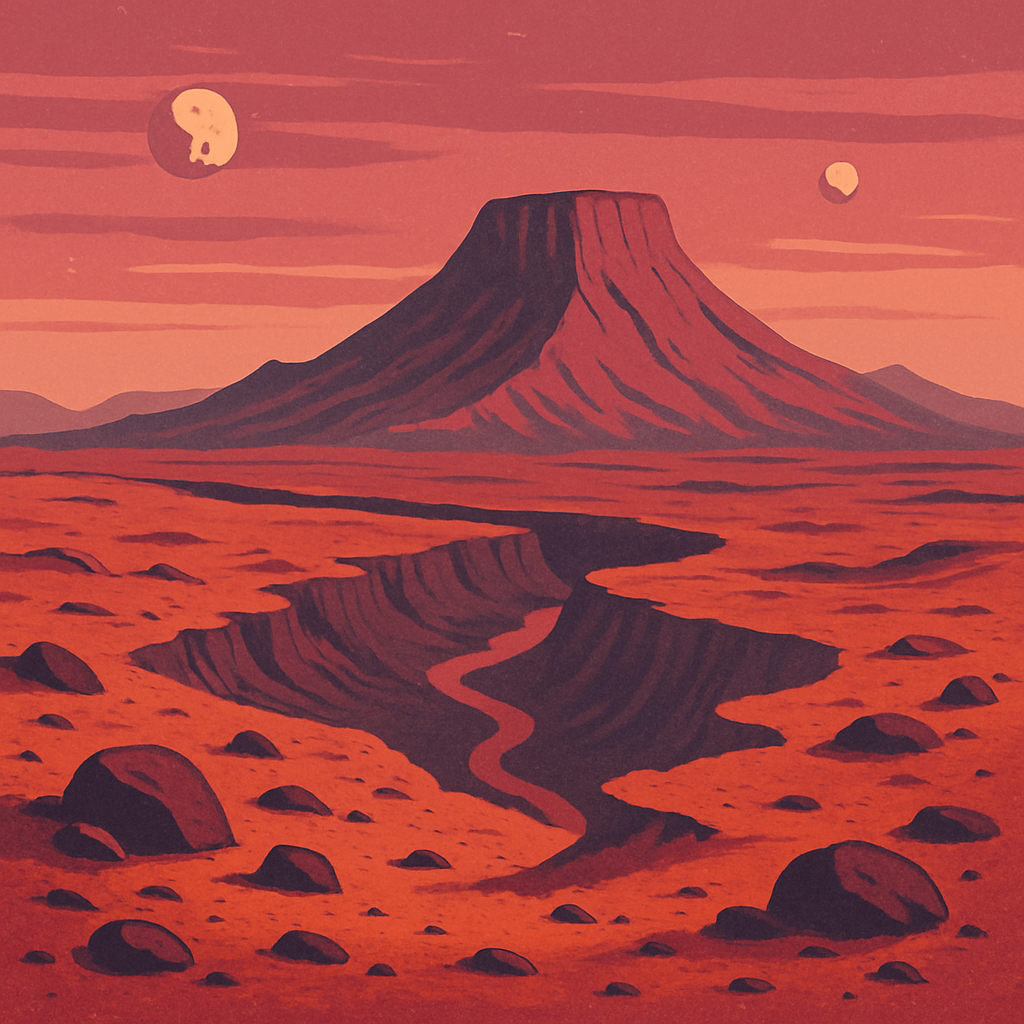
Mars, the fourth planet from the Sun, stands out in our solar system as a cold, dusty, and rocky world cloaked in a distinctive reddish hue caused by iron oxide, or rust, on its surface. Despite being about half the diameter of Earth and possessing just 10% of Earth’s mass, Mars covers a surface area comparable to our planet’s landmass, creating a landscape that intrigues scientists and space enthusiasts alike.
Orbiting the Sun at an average distance of 227.9 million kilometers—roughly 1.5 times farther than Earth—Mars experiences longer years, with one Martian year lasting 687 Earth days. However, its day length, known as a “sol,” is strikingly similar to Earth’s, lasting about 24 hours and 37 minutes.
Mars’ gravity, about one-third that of Earth at 3.711 m/s², affects everything from the planet’s atmosphere to potential future human missions. The thin atmosphere, composed predominantly of carbon dioxide (95.32%), with small amounts of nitrogen and argon, provides little insulation, leading to extreme temperatures: average lows of -55°C, plummeting to a frigid -133°C at winter poles and warming up to a mild +27°C during summer seasons.
Mars showcases some of the solar system’s most awe-inspiring geological features. Olympus Mons, the tallest volcano known, rises an astonishing 21.9 kilometers above the surface, dwarfing any terrestrial volcano. Nearby, the Valles Marineris canyon system stretches over 4,000 kilometers, a grand scar that testifies to the planet’s dynamic geological history.
The planet is accompanied by two irregularly shaped moons, Phobos and Deimos. Phobos, the larger moon, orbits merely 6,000 kilometers above the Martian surface, while Deimos travels at a distance of about 20,000 kilometers, both small compared to Earth’s moon but significant to Mars’ gravitational environment.
Humanity’s exploration of Mars has been revolutionized by robotic missions like NASA’s Perseverance and Curiosity rovers, which have delivered invaluable data on the planet’s geology and the tantalizing possibility that it might once have supported life.
Mars remains a beacon of scientific curiosity and discovery, helping us deepen our understanding of planetary formation and the conditions necessary for life beyond Earth. The Red Planet’s mysteries continue to inspire the pursuit of knowledge and the dream of one day walking its rust-colored soil.
Leave a Reply