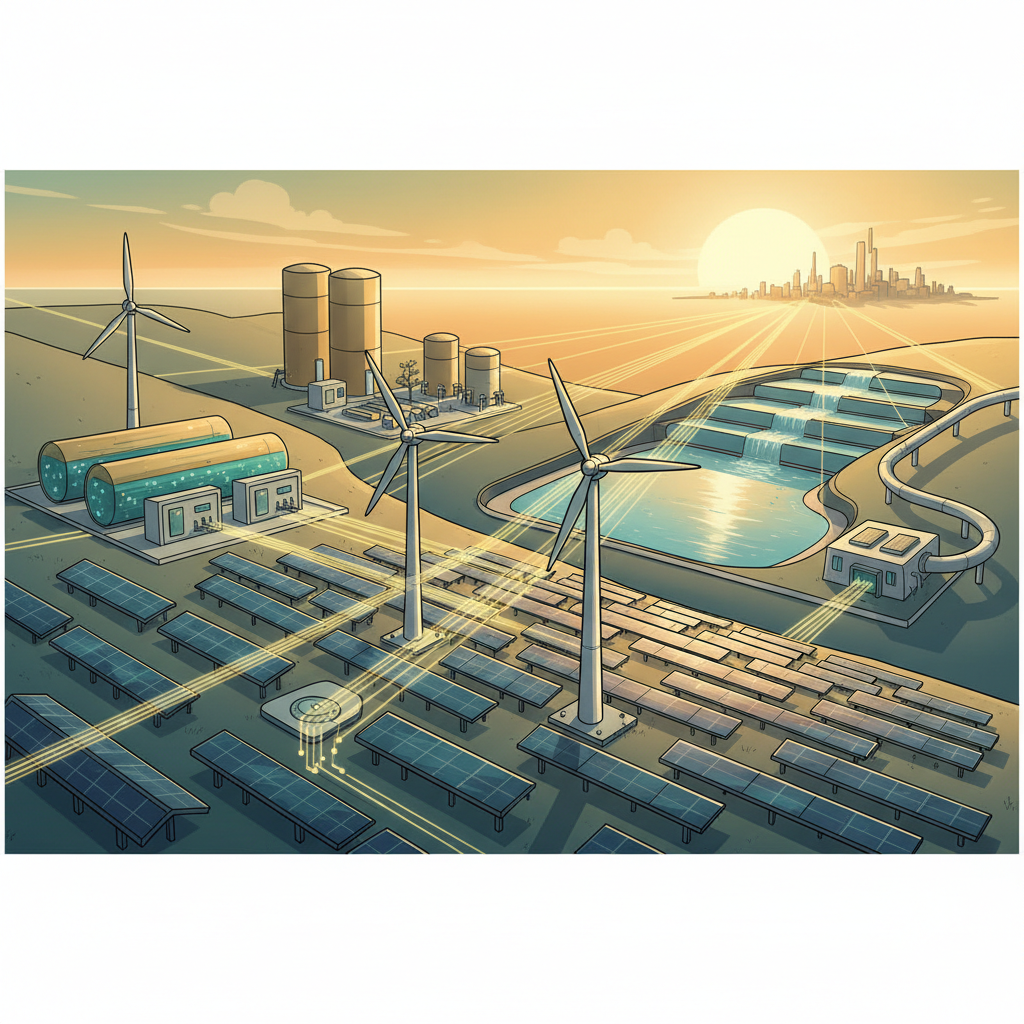
As solar and wind supply a growing share of electricity, the familiar problems of intermittency broaden from day‑night swings to multi‑day and seasonal imbalances. A Commentary in Nature Energy argues that meeting deep decarbonization goals cost‑effectively will require moving beyond today’s short‑duration batteries toward long‑duration energy storage (LDES) that can deliver energy for tens to thousands of hours — from several days up to seasonal storage.
Why does duration matter? Lithium‑ion batteries have proved transformational for diurnal balancing and fast grid services, but they are neither economical nor practical for holding large quantities of energy for days or months. Solar‑dominated systems face variability across many timescales: intra‑day peaks, stretches of low renewable output lasting multiple days, and seasonal mismatches between generation and demand. LDES technologies would fill that gap, enabling grids to shift energy across weeks and seasons and thereby unlock much deeper decarbonization.
The Commentary groups promising LDES pathways into broad technology classes and assesses their prospects. Electrochemical systems — notably flow batteries — stand out because they decouple power (kW) from energy (kWh) and can be scaled to long durations. Established chemistries such as vanadium redox flow are already being deployed, while new chemistries are being investigated to lower cost and broaden resource availability. Mechanical options include mature pumped hydro, which is highly cost‑effective where geography permits, and compressed air energy storage (CAES) with advanced adiabatic variants under consideration. Thermal storage approaches — from high‑temperature systems to seasonal thermal concepts and power‑to‑heat‑to‑power chains — can store very large quantities of energy, though they face conversion losses and integration challenges. Finally, chemical fuels produced by power‑to‑gas or power‑to‑liquid processes can provide seasonal storage and leverage existing fuel infrastructure, but their round‑trip efficiency is low and economics hinge on progress in electrolyzers and availability of carbon‑free feedstocks.
Crucially, the authors emphasize that the value of LDES is context‑dependent. Resource profiles, transmission expansion, demand flexibility and market design all shape what kinds of storage make sense in a given region. That means we should stop judging storage solely by a single metric such as levelized cost per MWh of stored energy. Useful evaluation must capture whole‑system value: duration, dispatchability, cycle life, interaction with transmission and demand response, and integration costs.
To accelerate deployment, the Commentary calls for coordinated R&D, demonstration projects and policy action. Priorities include improving cost and performance across candidate technologies (materials, scaling and manufacturing), producing representative performance and cost data from large demonstrations to reduce uncertainty, and creating markets and procurement mechanisms that recognize the distinct services long‑duration storage provides — from capacity and resource adequacy to seasonal shifting. The authors also urge expansion of modeling tools so planners can capture dynamics across multiple timescales and properly evaluate storage alongside transmission and demand‑side measures.
The article points to growing signals that multiple pathways are being pursued — from flow battery rollouts and advanced pumped‑hydro proposals to power‑to‑gas pilots — but it is careful to note limitations. As a Commentary, it synthesizes literature and expert judgment rather than presenting new experimental data, and it acknowledges uncertainty in future technology costs. Rather than prescribing a single winner, the authors recommend a pluralistic approach: support multiple technologies while using system‑level evaluation to determine where each option fits best.
For planners and policymakers working to integrate large amounts of solar, the takeaway is clear: short‑duration lithium‑ion batteries are necessary but not sufficient. Long‑duration storage — across electrochemical, mechanical, thermal and chemical pathways — is essential to bridge multi‑day and seasonal gaps and to deliver a reliable, zero‑carbon electricity system. Achieving that will require both technology innovation and new market and policy frameworks that recognize the unique value of duration.
Leave a Reply