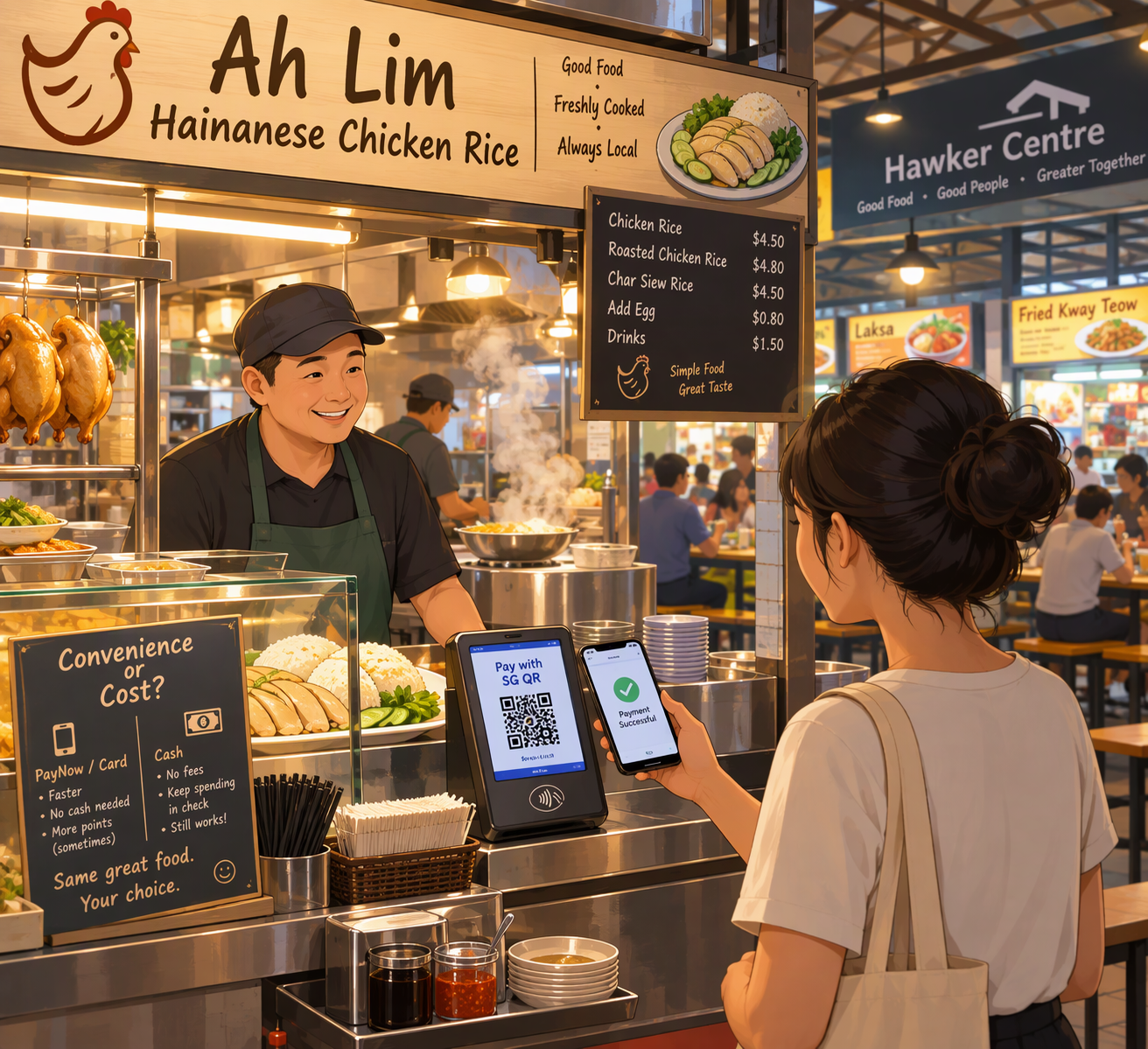
A quick tap or scan can make paying for lunch easy. But for hawkers, digital payments also come with a practical question: what does it cost to accept them? Since the government subsidy for SGQR ended on June 30, 2026, hawkers using the service pay a 0.5% transaction fee.
The subsidy had covered that fee on the first $20,000 of a stall’s monthly e-payment transactions. Hawkers who joined the programme by December 31, 2025, could receive the support until it ended. After that, stallholders had to decide whether SGQR’s convenience was worth the charge—or whether another payment method suited them better.
Some have switched. Chen Si-yuan, who has run a noodle stall at Hong Lim Complex Food Centre for five years, had used SGQR for about two years. After the subsidy ended, she began using personal PayNow or PayLah codes instead. She said those options do not bring the same fee for her, and that a transaction charge would cut into her margins when she had not raised prices.
Other hawkers interviewed were prepared to absorb the 0.5% fee. For one, SGQR’s audio alert confirming a payment is especially handy during a busy service. When food is being prepared, checking a phone for a PayNow notification may not be practical; a spoken alert can help the stallholder know a payment has come through.
The article’s visits to several hawker centres found that most stalls observed were still using SGQR, while only one or two had changed to personal PayNow after learning the subsidy had ended. Some stalls displayed SGQR for tourists who use cross-border payment options, while also offering personal PayNow or PayLah for local customers. The choices show that payment methods need not be identical from one stall—or one customer—to another.
NETS, the provider of SGQR, told 8world that the number of hawkers continuing to use the service and their transaction activity had stayed broadly around previous levels. It also reported double-digit year-on-year growth in hawker-centre SGQR payment volume from January to July 2026. SGQR supports 16 payment applications, including UOB TMRW and WeChat Pay, as well as cross-border payment options.
The chairman of the Hawkers’ Department of the Federation of Merchants’ Associations, Singapore, said the association had not received feedback from hawkers about the subsidy ending. He believed most would continue using SGQR because they found it convenient and secure.
There is no single response to the subsidy’s end: some hawkers prefer SGQR despite the fee, while others choose personal payment codes. The reporting offers a snapshot from selected centres and NETS’ figures, not a count of every stall’s decision. It also does not suggest that all stalls accept digital payments or that hawker centres have become cashless. For now, the story is one of practical choices—balancing cost, customer needs and what works behind the counter.
Source: 摊主乐学数码计划SGQR补贴结束 小贩须付手续费 多数继续使用, 8world
Leave a Reply