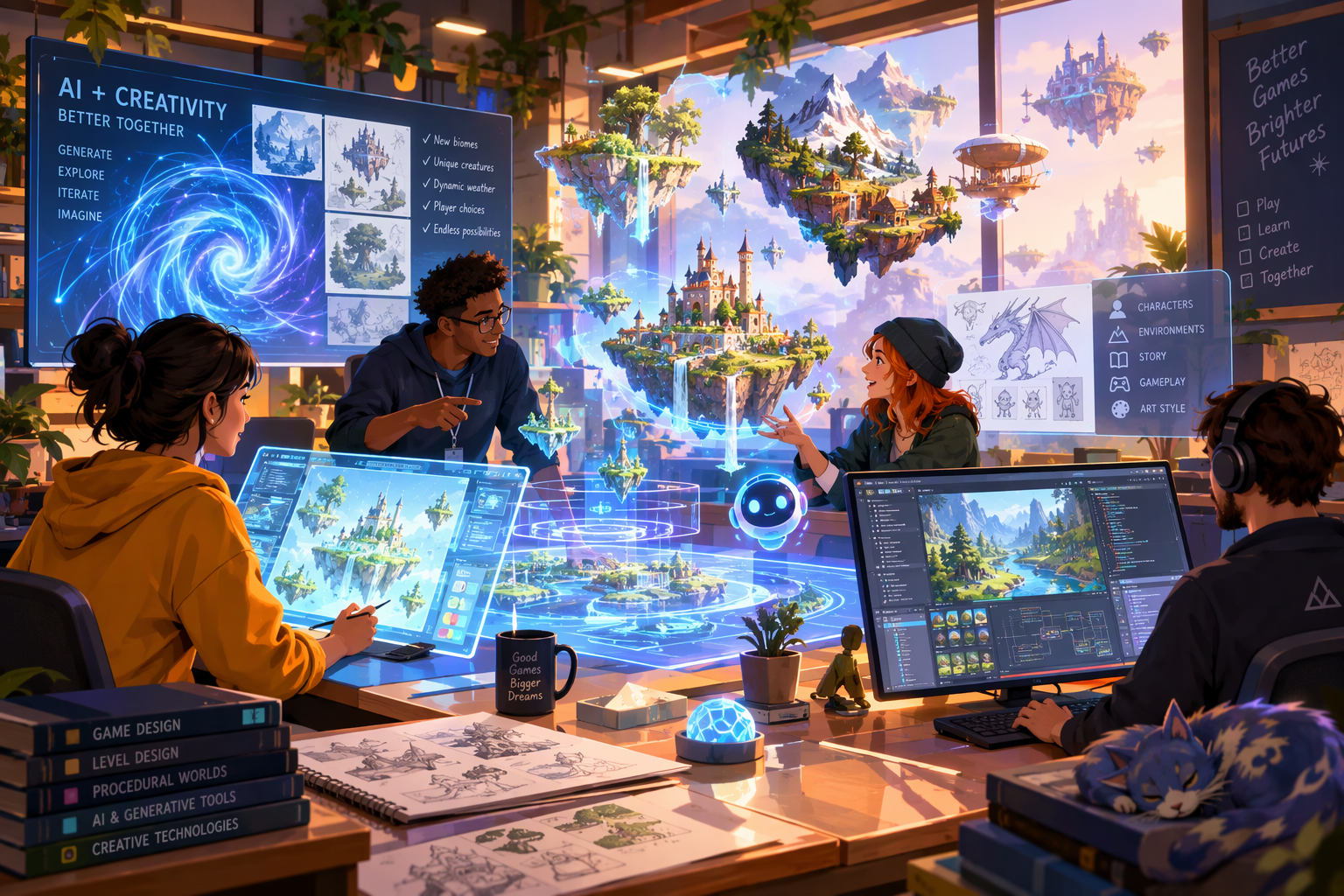
Imagine a game character answering a player in words that were created on the spot. That idea is no longer only a thought experiment: generative AI is being tried in several parts of video-game making, from early design work to features players can encounter. But the examples reported so far are a mix of production tools, proposals and experiments—not proof that AI has transformed games across the board.
TechRepublic reports that the 2025 State of the Game Industry report, released in March by Informa Festivals, found that one-third of developers use generative AI to streamline development. Possible uses include prototyping, exploring early concepts, and creating elements such as landscapes and sound effects. These are ways to help teams test ideas or develop material; the article does not measure whether they save time or money, or how they affect the finished game.
Some of the most striking examples remain demonstrations or proposed ideas. In March, a leaked Sony demonstration showed Aloy, from the Horizon franchise, responding to prompts with AI-generated dialogue in real time. That was not described as a released game feature. In May, Google Cloud proposed “living games” that could change in response to individual players’ experiences, while TechRepublic reports that Capcom was using Google’s Vertex AI and Gemini to iterate on item and environment art.
There has also been a player-facing experiment. In May, a character with real-time AI-generated dialogue appeared in Fortnite. The article identifies Google’s Gemini 2.0 Flash and ElevenLabs’ Flash v2.5 as the models powering that feature. It offers a glimpse of how a conversation in a game might become less fixed—but one example does not tell us how widely such features will be used or how players will respond.
AI can also work out of sight. Matías Rodriguez, CTO of Globant’s games and education AI studios, told TechRepublic that developers are interested in internal uses such as level-design prototyping, quality-assurance automation and content localization. These tasks may not be visible to players, yet they could shape how teams build and prepare games. The article, however, does not quantify their effects on development or jobs.
An earlier demonstration shows why the distinction between a game and an experiment matters. In 2023, Replica Studios worked on a demonstration for The Matrix Awakens, an Unreal Engine environment that TechRepublic clarifies was not itself a game. Replica, which the article says has since shut down, partnered with OpenAI on a tool that let developers set how characters could respond to natural-language input. Characters were prompted to speak as if they existed in The Matrix; their dialogue did not show that they were self-aware.
Together, these examples point to a field exploring many possibilities, while leaving big questions open. Could generative AI change creative jobs or human creativity? The article raises those concerns but does not offer measured answers. For now, the clearest picture is of developers testing tools and ideas—and of a conversation about where, and whether, they belong in games.
Source: Generative AI Use in Video Games Sparks ‘Heated Debates’, TechRepublic
Leave a Reply