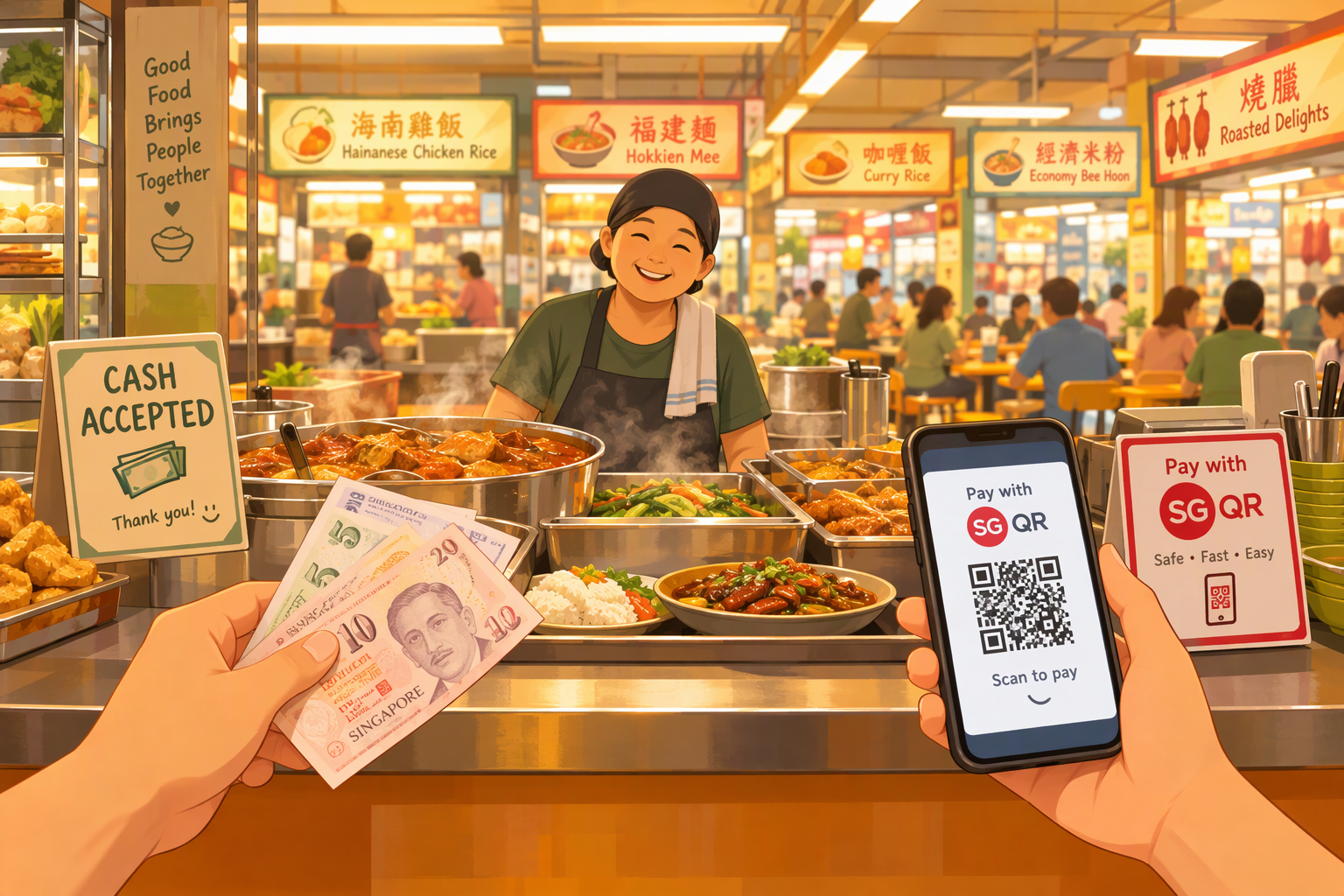
At some hawker stalls, paying for lunch means scanning a QR code. At others, cash remains the only option. Singapore’s move towards digital payments is changing how customers pay, but the experience at the counter shows why the transition is not the same for every hawker.
The Straits Times spoke with stallholders across eight hawker centres who had not adopted digital payments. Their reasons were practical: some found digital platforms difficult to use or remember, while others had trouble seeing screens or checking whether a transaction had gone through. There was also concern that customers might be delayed or inconvenienced as they used payment apps.
At West Coast Food Centre, 65-year-old noodle-stall owner Angie Sim accepts cash only. She said it was easier for her and suited many of her customers, whom she described as older and less familiar with technology. For her, sticking with cash is a way to keep the everyday exchange straightforward for both sides of the counter.
A drinks-stall owner in his 70s at ABC Brickworks Market & Food Centre described a different challenge: remembering how digital platforms work and verifying payments when business is busy. If a customer had no cash, he sometimes let the person take the drinks and return to pay later. At Albert Centre Market and Food Centre, another drinks-stall owner, in his 60s, also found checking electronic transactions troublesome. A vegetarian-stall owner at Alexandra Village Food Centre worried that a customer might say a payment had succeeded when it had not.
Yet QR payments can make work easier for other hawkers. More than 11,500 hawkers had started using SGQR, a standardised QR code introduced in 2018 to help stalls accept payments from multiple mobile wallets. Madeline Chen, who runs a braised-pork stall at Chinatown Complex Market & Food Centre, said digital payments reduced the work of handling cash, particularly when she was busy. Some regular customers even scanned a photograph of her SGQR code before collecting their food.
The Hawkers Go Digital programme began in 2020 to encourage adoption. Under the scheme described in the article, the government covered a 0.5 per cent transaction fee on the first $20,000 of a stall’s monthly e-payment transactions. On October 10, 2024, Enterprise Singapore and the Infocomm Media Development Authority announced that the fee subsidy would be extended until the end of 2025. The stated aim was to encourage digital payment adoption among 18,000 stallholders in government-run food centres.
The contrast is a reminder that digitalisation is a gradual change, not evidence that cash has vanished from hawker centres. QR payments offer convenience for some stallholders, while others weigh them against questions of access, confidence and payment checks. For now, the hawker-centre counter may offer a choice between newer technology and familiar cash—and that choice reflects the different needs of the people serving and buying the food.
Source: Why cash is still king for some hawkers in Singapore despite digitalisation push, The Straits Times
Leave a Reply