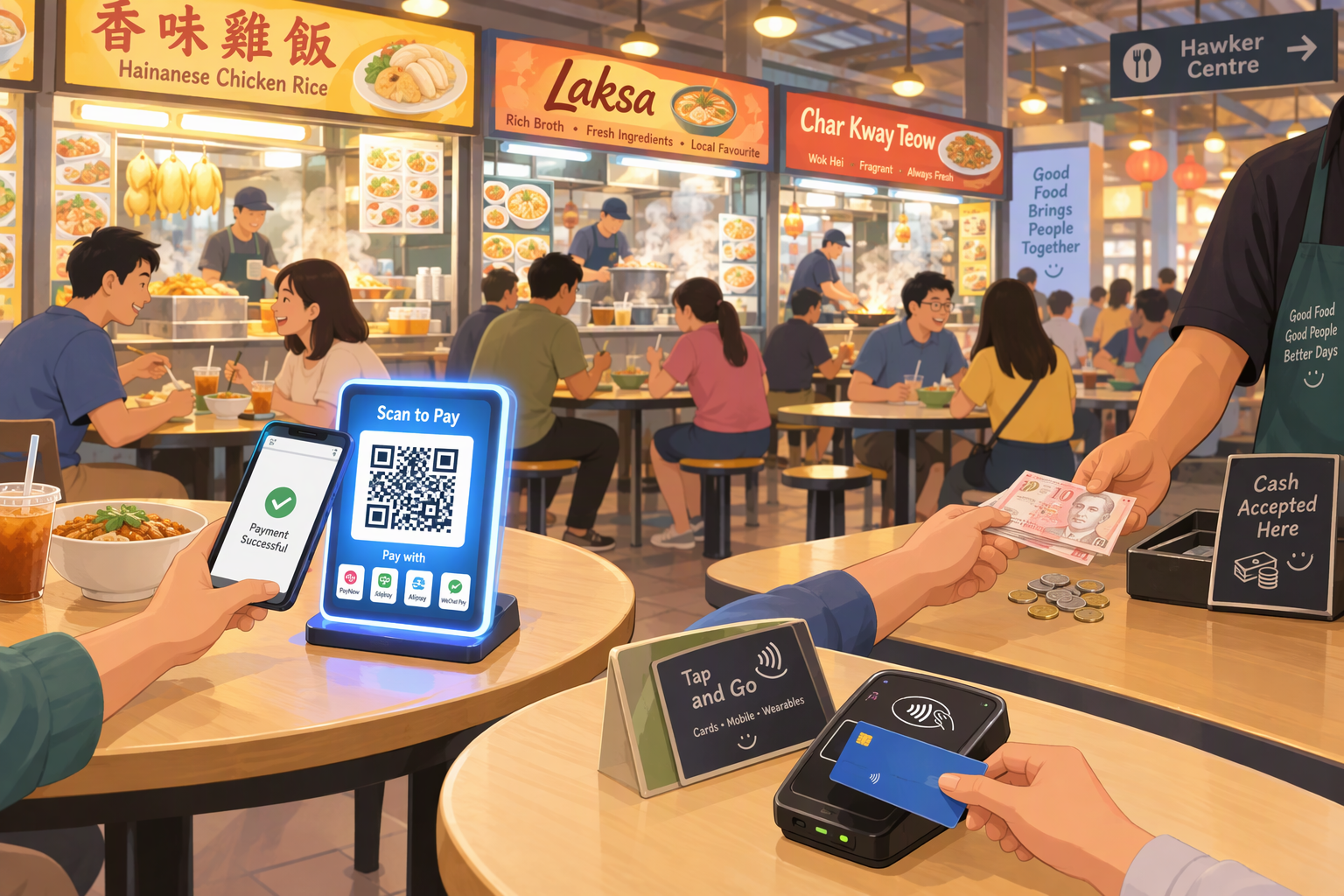
At a hawker centre, one person may scan a QR code while the next reaches for notes and coins. In Singapore, both scenes belong to the same changing payment landscape: digital options are becoming part of everyday life, but cash remains a familiar choice.
A survey featured in The Straits Times offers a snapshot of that mix. Commissioned by the newspaper and conducted by market research firm Kantar in December, it interviewed 1,000 Singapore citizens and permanent residents aged 18 to 65. Half of respondents were described as regular users of digital payments. Convenience was a leading draw: 54 per cent cited it as their strongest reason for using digital payments.
At hawker centres, the figures show that cashless payments have a presence—but not that cash has vanished. Half of respondents said they regularly use PayNow there, while 65 per cent said they regularly use cash. Because people could select more than one payment method, these percentages are not competing groups and do not add up to 100 per cent. Someone might use PayNow on one visit and cash on another.
Payment choices also depend on the setting. The article reports that credit and debit cards were more commonly used for public transport and grocery shopping. That variety suggests there is no single payment habit for every part of the day: people may choose one method for a hawker meal and another for a supermarket trip.
The article brings the numbers to life through two personal examples. Realtor and content creator Chloe Teo said she uses PayNow at hawker centres and when paying individual vendors, while using credit cards for other purchases. Retiree Liew C.B., aged 75, described using digital payments almost exclusively, except when a vendor accepts only cash. Their experiences illustrate different routines, but they are individual stories—not survey findings about all customers. Liew is also older than the survey’s 18-to-65 age range.
So what is changing at the hawker centre? The survey points to digital payments becoming one regular option, alongside cash. It does not count how many stalls accept cashless payments, identify particular centres, or show how adoption has changed over time. It also does not establish that hawker centres are becoming fully cashless.
For now, the picture is one of choice rather than replacement. Convenience helps explain why people use digital payments, while the survey figures show that cash still features prominently in hawker-centre routines. The next time you order a meal, the payment method may be digital—or it may still be cash.
Source: Singapore taps digital payments everywhere, but cash still lingers, The Straits Times
Leave a Reply