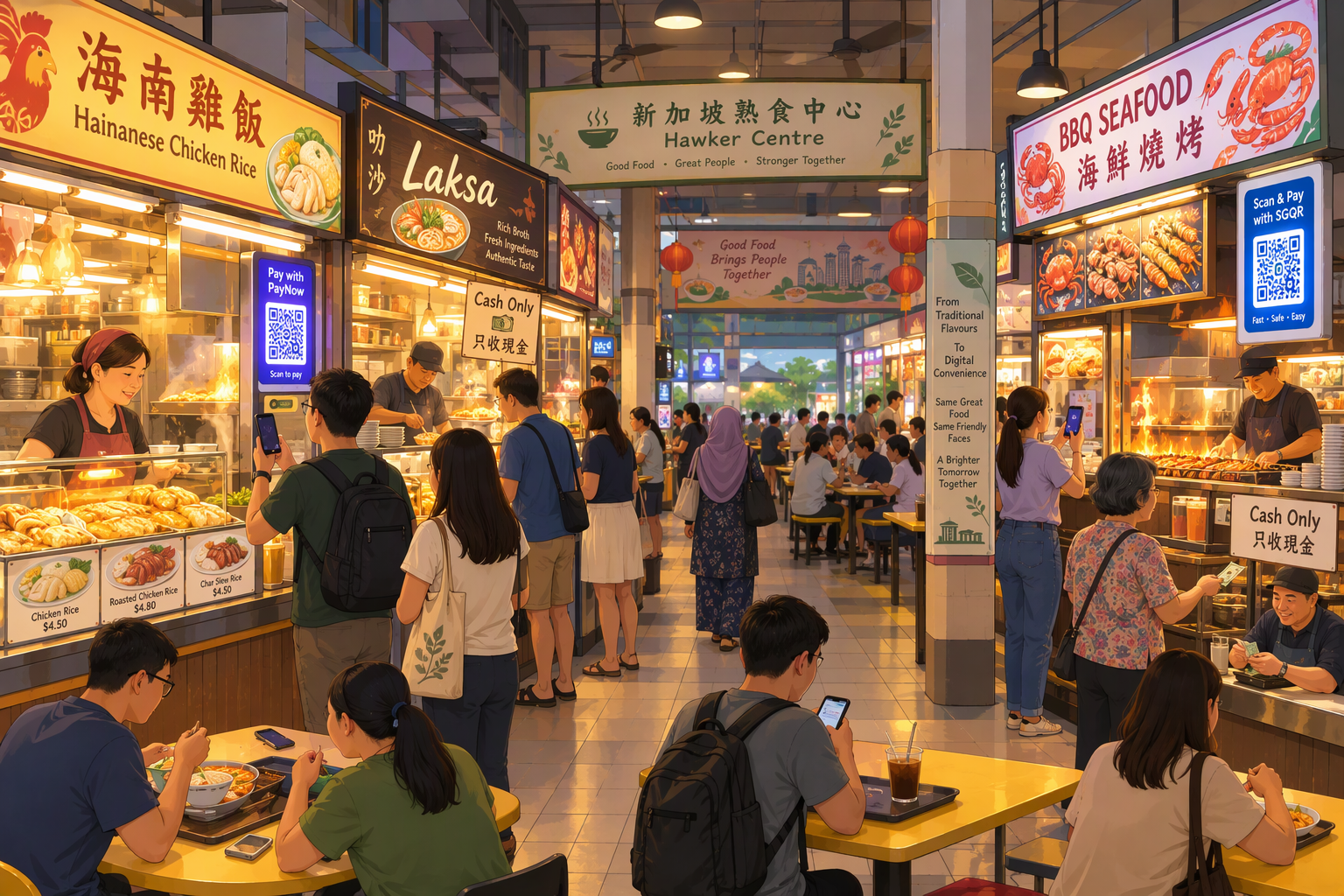
At one hawker centre, QR codes are easy to spot. At one noodle stall, a different message is just as clear: “Cash Only.” The contrast captures Singapore’s changing payment habits—not as a sudden switch from notes and coins to phones, but as a transition unfolding differently from stall to stall.
The Straits Times spoke with hawkers at eight centres who continued to avoid e-payments. Among them was Angie Sim, a 65-year-old noodle-stall owner at West Coast Food Centre. She said cash was easier for her and suited many of her older customers, who were less familiar with digital payments. For customers who usually carry cash, sticking with it can also be the simplest way to pay for a meal.
Still, QR-based payments have become increasingly visible. More than 11,500 hawkers had adopted SGQR, a standardised QR code launched in 2018 to make it easier to pay using different mobile e-wallets. The Hawkers Go Digital programme, which began in 2020, was part of a wider effort to get 18,000 stallholders in government-run food centres to accept digital payments.
The programme offered a practical incentive: hawkers did not pay the 0.5 per cent transaction fee on their first $20,000 of monthly transactions. On October 10, 2024, Enterprise Singapore and the Infocomm Media Development Authority said the fee waiver would be extended until the end of 2025. That announcement showed continued support for digital payments, but the article’s examples also made clear that encouragement and incentives do not remove every obstacle.
For some stallholders, using a digital platform can mean learning steps that are hard to remember, especially during a busy service. A drinks-stall owner in his 70s at ABC Brickworks Market & Food Centre said he found the platforms difficult to remember and checking whether payments had gone through challenging when customers were waiting. At Albert Centre Market and Food Centre, a drinks-stall owner in his 60s described transaction checks as troublesome. Other concerns included poor eyesight and the possibility of inconveniencing customers who struggle with their devices.
Yet hawkers who have adopted e-payments described advantages too. Madeline Chen, who runs a braised-pork stall alone at Chinatown Complex Market & Food Centre, said digital payments reduce the work of handling cash when she is busy. Some hawkers also told the paper that they had seen increased sales, particularly from younger customers, although no figures were given.
Together, these experiences show why a hawker centre’s payment landscape is not simply a story of old versus new. QR codes can make transactions easier for some stallholders, while cash remains more comfortable for others and their customers. The shift is happening, but each stall is navigating it in its own way.
Source: Why cash is still king for some hawkers in Singapore despite digitalisation push, The Straits Times
Leave a Reply