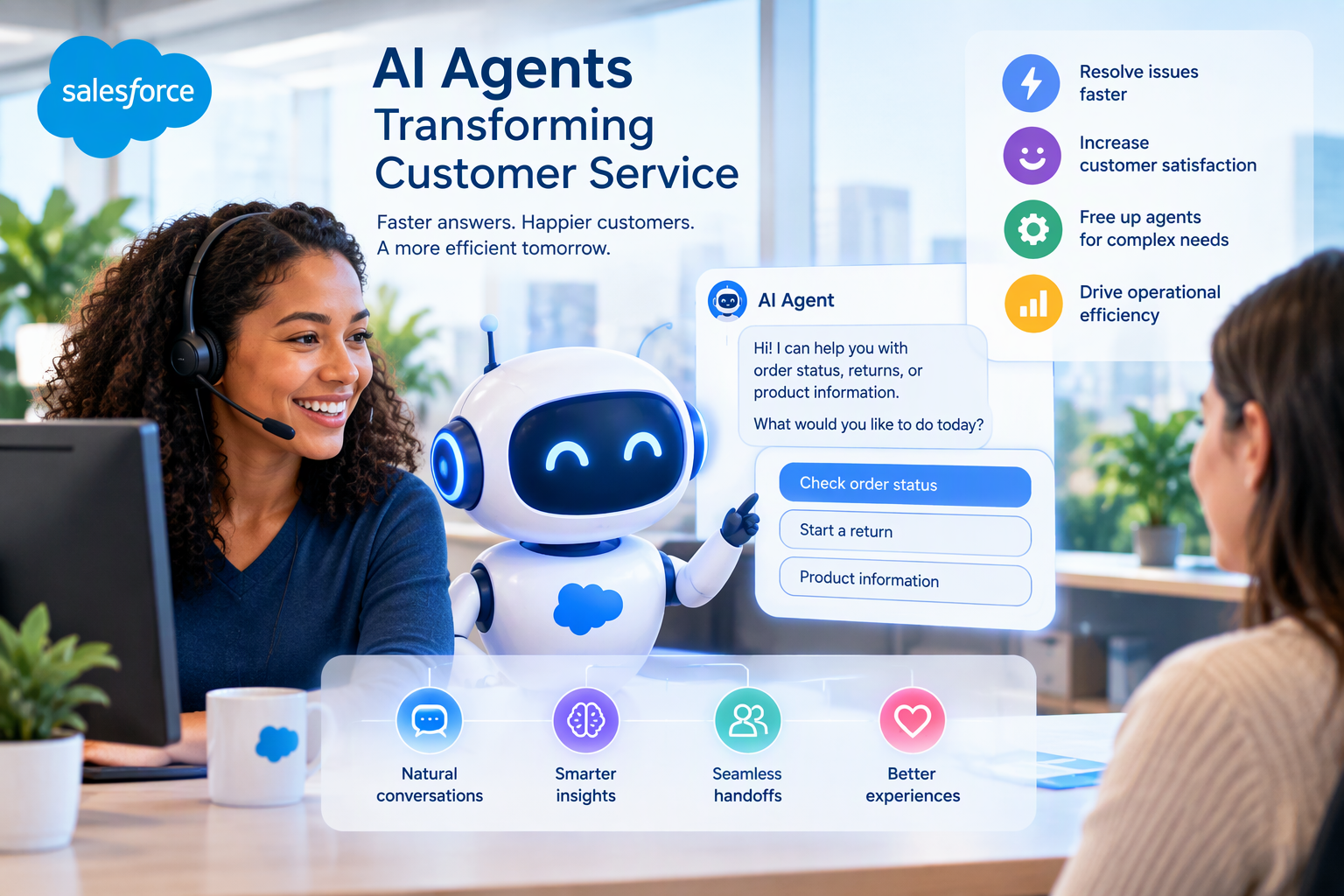
A customer-service request can involve more than answering a question. It may need to be sent to the right team, followed up across different channels or matched with a useful product suggestion. Salesforce’s latest report explores how AI agents are being used to take on some of this work—and what service organizations say they are seeing in return.
The company’s State of Service: AI Agents Edition surveyed 3,075 customer service professionals worldwide. According to the article, 66% of customer service organizations now use agentic AI, up from 39% in 2025. Salesforce describes these systems as autonomous AI that can take actions and support complex workflows. The article also reports that 85% of service organizations use at least one form of AI.
These agents may interact with customers, or help service teams behind the scenes. Customer-facing tasks listed in the report include proactive outreach, personalized product recommendations and resolving cases across multiple channels. Internal tasks can include routing a case to the appropriate service representative. In other words, AI agents may be part of both the conversation customers see and the process that helps a service team handle it.
The report says 77% of service teams using AI agents deploy them in both customer-facing and internal operations. That points to a broad role for the technology within those teams: not simply answering customers, but also helping coordinate the work around their requests. The article does not provide specific company examples, so it offers a survey-wide picture rather than a close look at individual deployments.
Salesforce also reports that 70% of organizations with AI service agents observed measurable value within 60 days of deployment. Among the measures reported, customer satisfaction was the most improved KPI, ahead of service-representative productivity, average handle time, customer retention and first-response time. The findings suggest that surveyed organizations see AI agents as relevant to customer-service outcomes as well as operational tasks.
There are important limits to what these figures tell us. The article does not give the survey’s full methodology or a breakdown of respondents and organizations, nor does it explain in detail how reported improvements were measured. It also does not establish that AI agents caused the customer-satisfaction gains or provide independent verification. The results are therefore a snapshot of what surveyed organizations reported—not proof that every service team will see the same results.
As AI agents become more common in customer service, the key question is not only what tasks they can take on, but how organizations assess their effects. Salesforce’s survey offers one view of that changing landscape, while leaving room for further evidence about how these systems perform in different settings.
Source: New Research: AI Service Agents Improve Customer Satisfaction, Salesforce
Leave a Reply