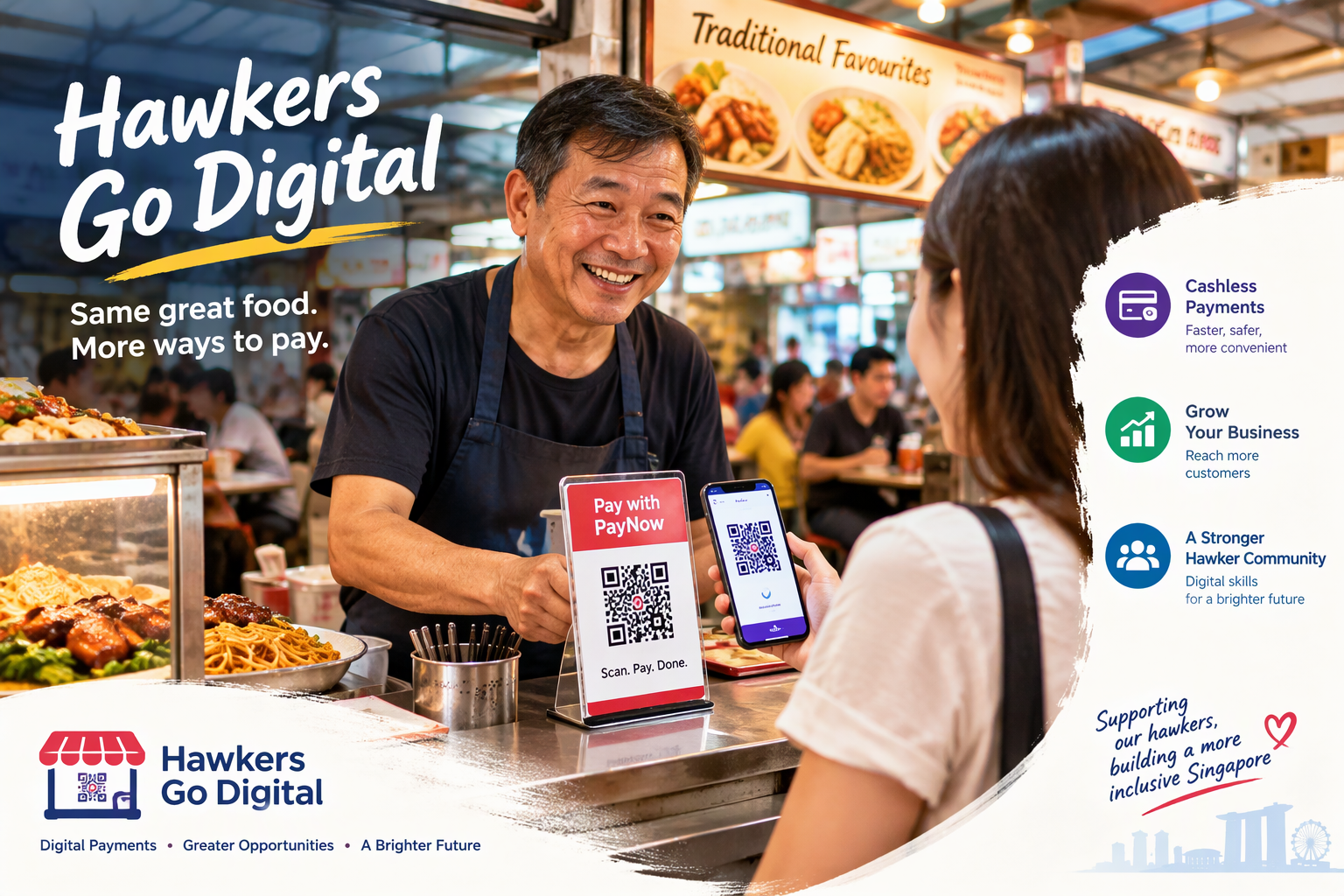
At a hawker centre, a meal might be paid for with a few notes, a card, or a scan of a QR code. For stallholders using digital payments, that scan can make a sale quicker—but transaction fees and the costs of running a stall matter too. In October 2024, Singapore’s Hawkers Go Digital programme received another extension to help operators make the adjustment.
By then, more than 11,500 hawkers had adopted cashless payments through the programme. It encouraged food-stall operators to accept digital payments using QR codes on the Singapore Quick Response Code, or SGQR, platform. The subsidy was extended through the end of 2025, giving participating stallholders more time to use the system while getting used to transaction fees.
Under the subsidy described in the article, a stall’s 0.5 per cent transaction fee was waived on the first $20,000 of digital transactions each month. Enterprise Singapore and the Infocomm Media Development Authority (IMDA) said the extension followed feedback from hawkers. It was also intended to encourage continued adoption as stallholders faced rising operating costs.
The programme has had a longer journey. SGQR was introduced by Enterprise Singapore and IMDA in 2018. Hawkers Go Digital aimed to encourage about 18,000 stallholders in government-run food centres to adopt digital payments before subsidies were lifted. These included centres operated by the National Environment Agency and the Housing Board.
The subsidy’s finish line shifted more than once. It had initially been scheduled to end on December 31, 2023. In October 2023, the end date moved to the end of 2024; a year later, it was extended again, through the end of 2025. The changes reflected an effort to give stallholders more time to adapt.
The figures in the article show that digital payments were growing among participating hawkers. In August 2024, monthly transaction value reached $60 million, compared with $45 million in August 2023. Transaction volume also rose over that period, from 5.4 million to 7.6 million. Senior Minister of State Low Yen Ling described the scheme as part of efforts to help hawkers thrive in the digital age.
Still, adopting digital payments does not mean every stall is cashless. The article does not say that all hawker stalls or centres accept them, or that cash is no longer accepted. It also does not say which payment apps are available at every stall. What it does show is a gradual shift: more participating hawkers were using QR payments, and the subsidy was extended to support that transition. The reported extension ran through December 31, 2025; the article does not establish what happened after that date.
Source: Subsidy for hawkers to adopt digital payments extended to end-2025, The Straits Times
Leave a Reply