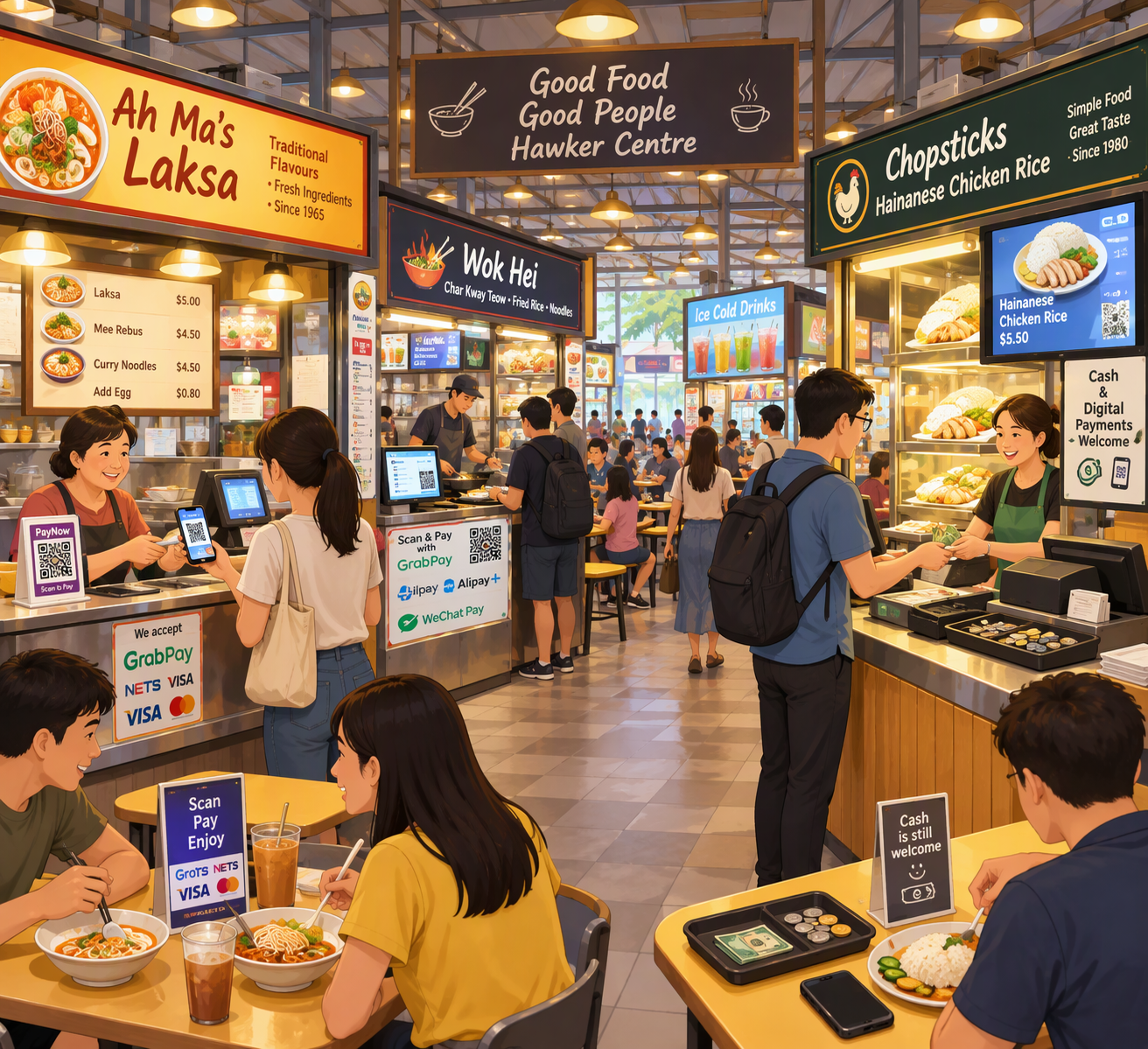
At a hawker centre, paying for lunch might take a quick scan of a QR code—or a few coins passed across the counter. As more stalls adopt digital payments, some hawkers still prefer cash. Their reasons show that the move to e-payments is not the same for everyone.
At West Coast Food Centre, noodle-stall owner Angie Sim displays a “Cash Only” sign. The 65-year-old, who has worked there with her stall partner for more than 20 years, told The Straits Times that cash is easier and more convenient for her. Many of her customers, she said, are older, less familiar with technology and used to carrying cash.
Other stallholders described practical difficulties with digital payments. Learning how to use a platform can be challenging, and poor eyesight may make a screen harder to navigate. Hawkers may also need to check whether a payment has gone through—something that can be stressful when customers are waiting.
At ABC Brickworks Market & Food Centre, a drinks-stall owner in his 70s said he found it difficult to remember how to use digital platforms and verify payments during busy periods. If a customer did not have cash, he sometimes gave them the drink and let them return to pay. At Albert Centre Market and Food Centre, drinks-stall owner Mr Tan, who is in his 60s, described payment verification as troublesome.
But other hawkers find that digital payments make work easier. Madeline Chen, who runs a braised-pork stall at Chinatown Complex Market & Food Centre, said e-payments reduce the hassle of handling cash, especially when she is busy. Some of her regular customers had even photographed her SGQR code so they could pay before collecting their food.
The article reported that more than 11,500 hawkers had adopted SGQR, a standardised QR code introduced in 2018 to make it easier to accept payments from multiple mobile e-wallets. It also described the Hawkers Go Digital programme, launched in 2020. At the time of the article’s publication in November 2024, the programme waived a 0.5 per cent transaction fee on each stall’s first S$20,000 in monthly e-payment transactions. An announcement in October 2024 extended that waiver to the end of 2025 and set a goal of bringing about 18,000 stallholders in government-run food centres onto digital payments.
These examples from eight hawker centres capture a transition with different experiences on the ground. For some stallholders, scanning and paying can save the effort of handling cash. For others, cash feels simpler for them and their customers. Digitalisation may be changing how people pay for hawker food, but the article’s accounts show why the shift is not one-size-fits-all.
Source: Why cash is still king for some hawkers in Singapore despite digitalisation push, The Straits Times
Leave a Reply