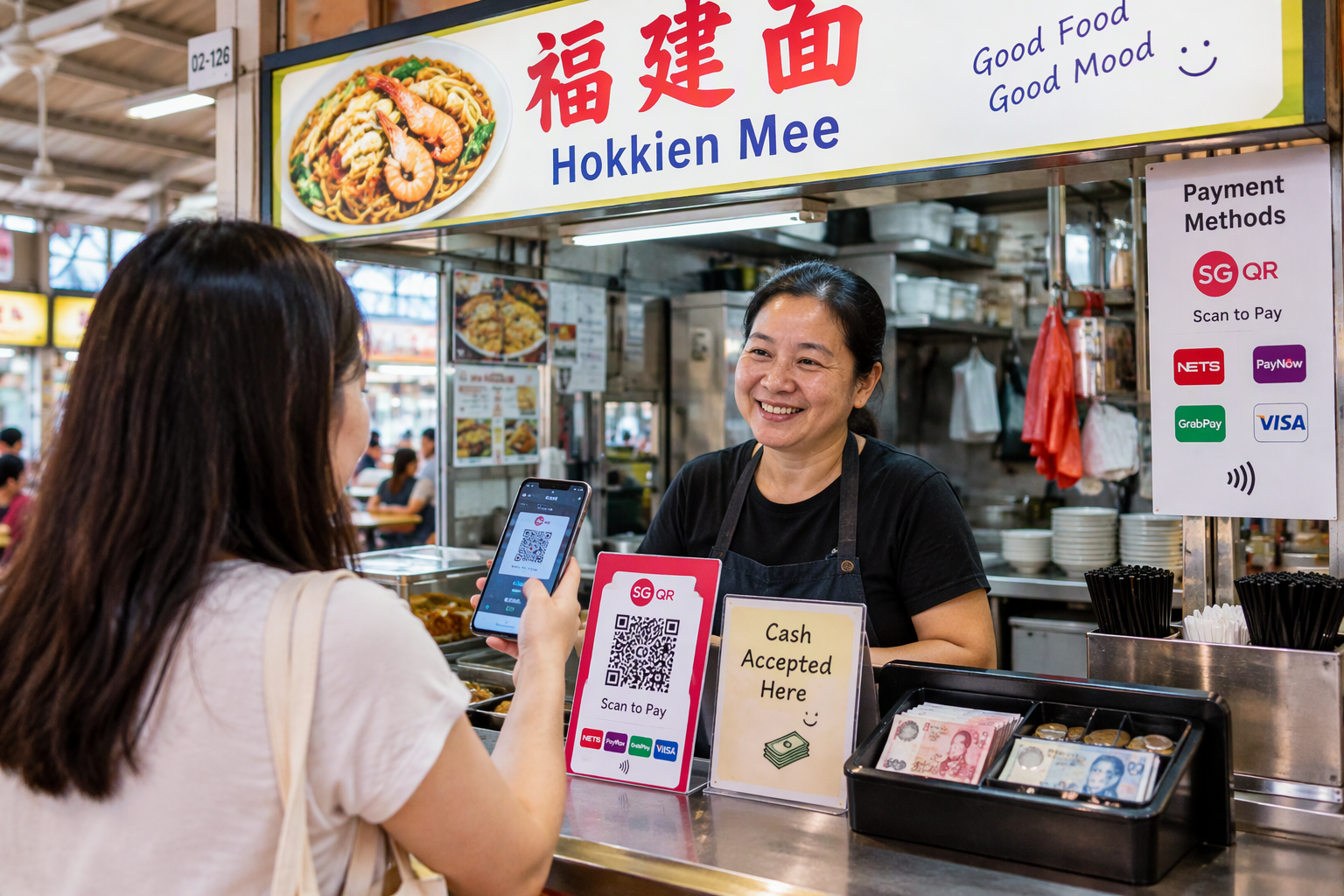
At a hawker centre, paying for lunch can be as simple as scanning a QR code. Yet beside the stalls displaying those codes, some hawkers still prefer the familiar feel of notes and coins. Singapore’s push towards digital payments is changing how customers pay—but, as The Straits Times reported, cash remains important to some stallholders and their customers.
At West Coast Food Centre, many stalls had QR codes on display. Noodle-stall owner Angie Sim, however, put up a “Cash Only” sign. The 65-year-old said cash was easier and more convenient for her. Many of her customers were older, less comfortable with technology and used to carrying cash. Sim and her stall partner had worked at the centre for more than 20 years.
Her reasons reflect a wider range of concerns. The newspaper spoke with stallholders across eight hawker centres who had not adopted digital payments or still preferred cash. Some described limited confidence with technology; others mentioned poor eyesight or difficulty using devices. A busy stall also leaves little time to pause and work through a payment process. Stallholders worried that a transaction taking longer might inconvenience customers.
For one drinks-stall owner in his 70s at ABC Brickworks Market & Food Centre, remembering how to use digital platforms was difficult. So was checking whether a payment had gone through, especially when the stall was busy. He said that if a customer had no cash, he sometimes made the drink and let the person return to pay later. At Albert Centre Market and Food Centre, a drinks-stall owner in his 60s called e-payment troublesome because he had to verify each transaction.
These examples show that adopting a payment system is not simply a matter of putting up a QR code. It also means learning how to use it, checking payments and fitting those steps into the quick rhythm of a hawker stall. A tool that feels straightforward to one person may be stressful or inconvenient to another.
Still, digital payments had made substantial inroads. The article reported that more than 11,500 hawkers had adopted SGQR, a standardised QR code launched in 2018 to support payments from multiple mobile e-wallets. Under the Hawkers Go Digital programme, hawkers using SGQR did not pay a 0.5 per cent transaction fee on their first $20,000 of monthly transactions. Enterprise Singapore and the Infocomm Media Development Authority announced on October 10 that this waiver would be extended to the end of 2025, with the stated aim of encouraging digital-payment adoption among 18,000 stallholders in government-run food centres.
The picture is not one of cash disappearing overnight. Digital options are spreading, supported by incentives, but some hawkers and customers continue to rely on cash for practical reasons. In a place where a quick meal is part of everyday life, making payments easier means recognising that different people may need different ways to pay.
Source: Why cash is still king for some hawkers in Singapore despite digitalisation push, The Straits Times
Leave a Reply