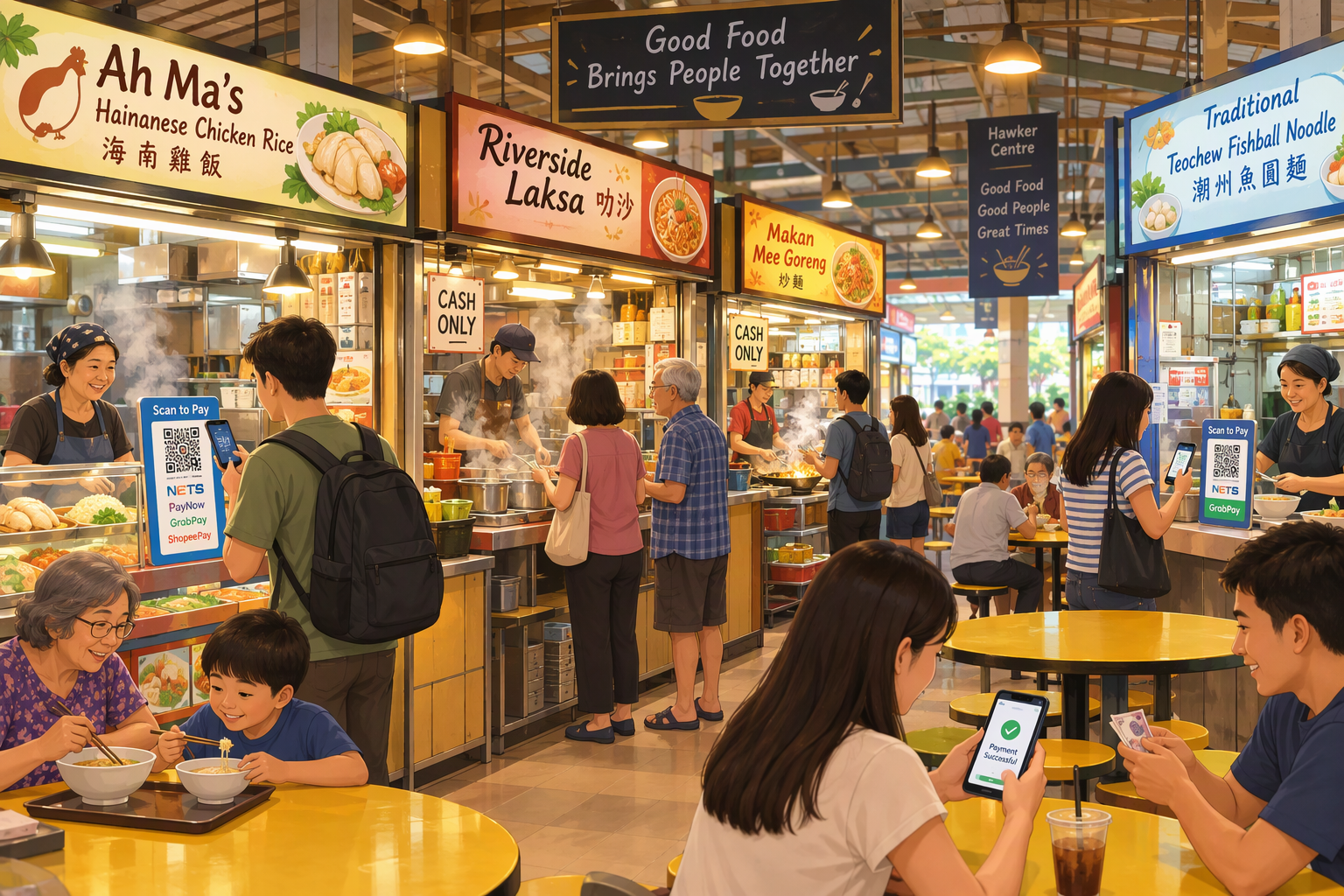
At a hawker centre, paying for lunch can take just a quick scan of a QR code. But not every stall has made that switch. For some hawkers, cash remains the simpler choice—and their reasons are closely tied to the people and routines around the stall.
At West Coast Food Centre, 65-year-old noodle-stall owner Angie Sim puts it plainly with a “Cash Only” sign. She says cash is easier and more convenient, and many of her customers are older, less comfortable with technology and used to carrying cash. Sim has worked at the centre with her stall partner for more than 20 years.
Her experience is not the only one. The Straits Times spoke to stallholders at seven other hawker centres who had not adopted digital payments. Some cited limited confidence with technology or poor eyesight. Others worried that using a device to check payments could slow things down or inconvenience customers.
For a drinks-stall owner in his 70s at ABC Brickworks Market & Food Centre, remembering how to use digital platforms—and confirming that a payment had gone through—could be difficult, especially during a busy spell. If a customer had no cash, he sometimes served the drink and let the person return to pay later. At Albert Centre Market & Food Centre, drinks-stall owner Mr Tan, who is in his 60s, said he found e-payment troublesome because he had to verify every transaction. A 60-year-old vegetarian-stall owner at Alexandra Village Food Centre also worried that a customer might say a payment had been made when it had not succeeded.
Yet the article also shows why other hawkers welcome the change. Madeline Chen runs a braised-pork stall on her own at Chinatown Complex Market & Food Centre. She said e-payment meant less hassle handling cash, especially when she was busy. Some hawkers also reported increased sales, particularly from younger customers. But slow processing during peak periods could put stallholders off, showing that digital payment is not automatically the smoother option in every situation.
The shift was growing, though not complete. At the time of the article’s publication in November 2024, more than 11,500 hawkers had adopted SGQR, a standardised QR code launched in 2018 that supports payments through multiple mobile e-wallets. The Hawkers Go Digital programme, launched in 2020, subsidised the 0.5 per cent transaction fee on a stall’s first $20,000 of monthly e-payment transactions. On October 10, 2024, Enterprise Singapore and the Infocomm Media Development Authority announced that the fee waiver would continue until the end of 2025. The programme aimed to encourage the 18,000 stallholders in government-run food centres to adopt digital payments.
The picture is not of cash disappearing overnight. QR codes are appearing across hawker centres, while some stalls still rely on cash for practical reasons. For customers, that makes a small habit worthwhile: check how a stall accepts payment, and be ready to pay in the way that works for both sides.
Source: Why cash is still king for some hawkers in Singapore despite digitalisation push, The Straits Times
Leave a Reply