
Author: Peter Kenny

  • Mines, Missiles, and a Chokepoint: The Strait of Hormuz Crisis Hits Global Shipping and Oil

    Mines, Missiles, and a Chokepoint: The Strait of Hormuz Crisis Hits Global Shipping and Oil

    Tensions around the Strait of Hormuz—one of the world’s most critical routes for oil—have sharpened into a fast-moving maritime crisis, as multiple reports describe Iranian mine activity, US strikes on alleged mine-laying vessels, and merchant ships coming under attack.

    According to CNN, Iran has begun laying mines in the Strait of Hormuz, described as the world’s most important energy chokepoint and a corridor carrying about one-fifth of all crude oil. The report cites two people familiar with US intelligence on the issue and notes that the uncertainty is already feeding fears about disruptions to energy flows.

    From there, events appear to have escalated quickly. The Guardian reported that the US attacked Iran’s “mine-laying boats” in the Strait of Hormuz as tensions rose over oil. In the same Guardian briefing, Iran’s Revolutionary Guards (IRGC) were quoted warning that they would not allow even “one litre of oil” to leave the region if US-Israeli attacks continued.

    A separate Guardian report described direct impacts on commercial shipping, saying three merchant ships were struck as tensions rose in the strait amid the Iran war. The article reported that the crew of a Thai-registered bulk carrier was forced to flee a fire, and that the US said it had destroyed 16 Iranian mine-laying vessels.

    CNBC likewise reported that US forces sank 16 Iranian minelayers amid reports that Tehran is mining the Strait of Hormuz. CNBC also highlighted the market stakes: oil prices have spiked sharply since the conflict intensified, and it noted a warning attributed to US President Donald Trump of “military consequences … at a level never seen before” if mines were not removed.

    France 24 framed the mine threat as a potential strategy to “choke off oil traffic” through the strait following US and Israeli strikes on Iran, raising fears that Tehran could deploy sea mines, according to officials cited in its report.

    As the headlines pile up, so do competing narratives. A Reddit thread titled “There are no mines in the Strait of Hormuz” pointed to claims circulating on Telegram and referenced an Iranian Navy statement suggesting control of the strait is carried out by missiles and drones—underscoring how public information, official statements, and online assertions can collide in real time during a rapidly developing conflict.

    Across these reports, one point is consistent: the Strait of Hormuz is not just a narrow strip of water on a map—it’s a pressure point where military action, merchant shipping risk, and oil market volatility converge. When the threat shifts from rhetoric to mines, strikes, and burning vessels, the world’s energy and trade systems feel it immediately.
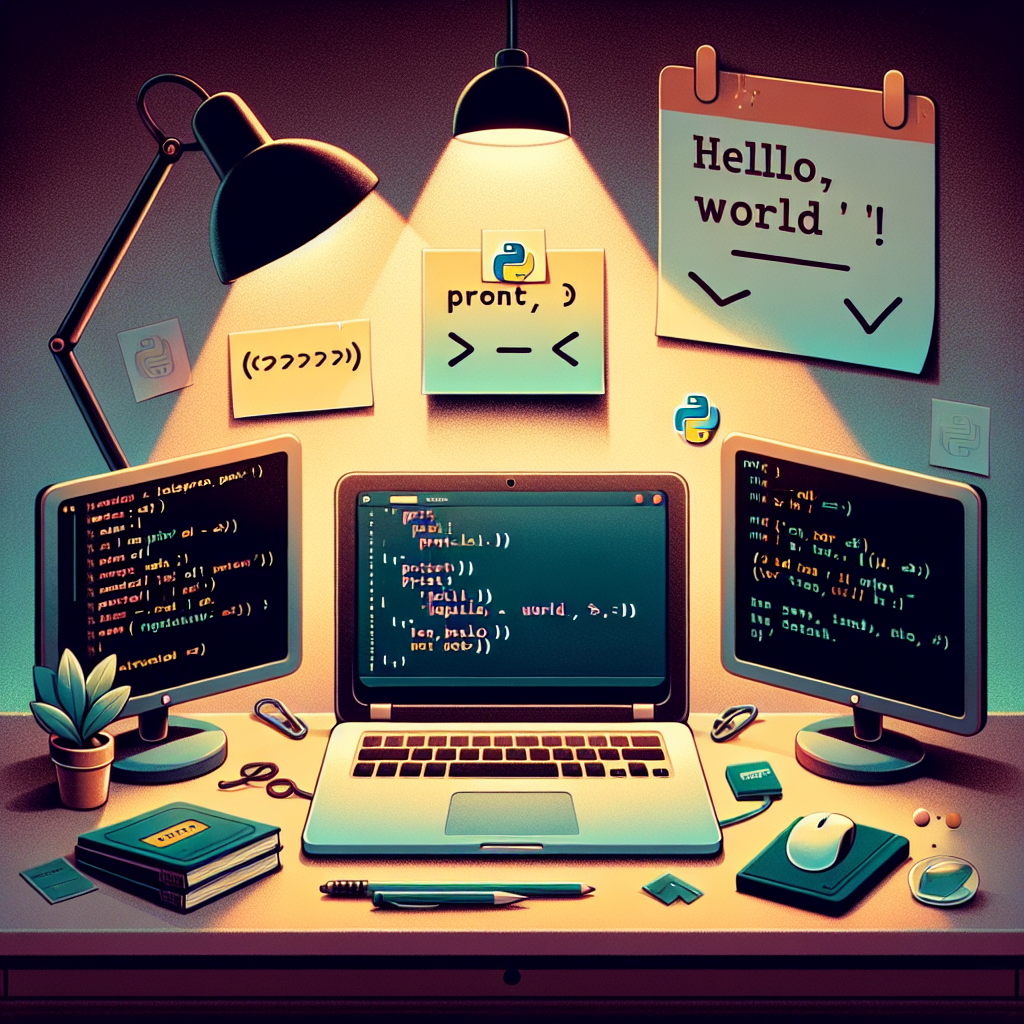

  • Why “Hello, World!” Still Trips Us Up in Python

    Why “Hello, World!” Still Trips Us Up in Python

    “Hello, World!” is supposed to be the easiest win in programming. Python even has a reputation for being “very simple” with “straightforward syntax” and for letting you write code without a lot of boilerplate. And yet, the internet is full of beginners getting stopped cold by that first line.

    Looking across a handful of tutorials and forum threads, a clear pattern emerges: “Hello, World!” isn’t hard because the message is complicated—it’s hard because it’s often your first encounter with context.

    ## The promise: a tiny program with tiny syntax
    A basic Python “Hello, World!” is about as minimal as it gets. In modern Python, it’s typically written as:

    print(“Hello, World!”)

    That single line reflects Python’s emphasis on clarity and minimal setup.

    ## The reality: most “Hello, World!” problems aren’t about the words
    The most common issues people run into are not conceptual—they’re environmental or version-related.

    ### 1) Python 2 vs Python 3: the `print` change
    A classic stumbling block is copying older syntax into a newer interpreter. One frequently cited example is:

    print “Hello, World!”

    In Python 3, that can produce a `SyntaxError: invalid syntax` because `print` is now a function and needs parentheses. The fix is simply the Python 3 form:

    print(“Hello, World!”)

    Some references still point out the historical split: Python 2 used `print` without parentheses, while Python 3 expects parentheses.

    ### 2) Running commands in the wrong place: shell vs interpreter
    Another frequent “invalid syntax” moment comes from typing a command meant for your system’s command line into the Python interpreter.

    In one Python.org discussion, a learner tried to run something like `python/Desktop.intro.py` and hit an error. The key detail: they entered it at the Python prompt (the `>>>` prompt), not in the system shell.

    The replies emphasized that the prompt is a clue:
    – `>>>` means you’re inside the Python interpreter
    – commands to start Python or run a file belong in a shell/terminal

    On Windows, the same thread also notes a recommendation to use the Python Launcher with `py`.

    ### 3) “It works locally, but not on the platform”: printing vs returning
    When “Hello, World!” shows up inside a learning platform, it sometimes isn’t asking you to print anything at all.

    On Exercism’s Python track, learners reported frustration because their output “worked on python but doesn’t work on the exercism platform.” The issue, as explained in the discussion: the exercise expects you to implement a function that **returns** the string, not prints it.

    In other words, “say ‘Hello, World!’” can really mean “return the exact string `”Hello, World!”` from a function,” because automated unit tests are checking return values.

    This leads to another subtle beginner lesson: tests are strict. Exact matches matter—right capitalization, punctuation, and spacing.

    ### 4) Tooling surprises: when your editor says “Finished” but nothing prints
    Even if your code is correct, your editor configuration can mislead you.

    One Sublime Text user described having Python working fine in a terminal, but when they used Sublime’s Build command on:

    print(“Hello world!”)

    they only saw:

    [Finished in 0.1s]

    The takeaway from that thread is that the editor may be running something successfully, but your build configuration (or where output is displayed) can make it look like nothing happened.

    ## The real lesson of “Hello, World!”: context is part of programming
    Taken together, these stories explain why “Hello, World!” persists as a rite of passage. It’s not just about printing text—it’s about learning what environment you’re in (shell vs interpreter), what version you’re using (Python 2 vs 3), what a platform expects (print vs return), and how your tools show output.

    Python’s syntax may be straightforward, but your first program sits at the intersection of code, tooling, and expectations. When you finally see “Hello, World!” appear the way you intended, it’s not just a greeting—it’s confirmation that all those pieces are lined up.

  • Bitcoin, Gold, and the US Dollar: What the Research Says About “Hybrid” Safe Havens

    Bitcoin, Gold, and the US Dollar: What the Research Says About “Hybrid” Safe Havens

    Bitcoin is often discussed in the same breath as gold and the US dollar—sometimes even described as something “in between” the two. But across the research summarized in the articles provided, a consistent message emerges: when Bitcoin is tested against gold and the dollar using formal statistical methods, it tends to behave differently rather than like a clean hybrid.

    One paper, “Bitcoin, gold and the US dollar – A replication and extension” (Finance Research Letters), revisits earlier work that argued Bitcoin could be classified between gold (a commodity currency) and the US dollar (a fiat currency). Using the same sample and econometric models to replicate the earlier findings, the authors report that exact replication is not possible. They also state that alternative statistical methods produce results that are “more reliable, yet very different.” In both the original and an extended sample period, the study finds Bitcoin has distinct return, volatility, and correlation characteristics compared to other assets—including gold and the US dollar.

    A second study, “Dependence and Risk Spillover among Hedging Assets: Evidence from Bitcoin, Gold, and USD” (Discrete Dynamics in Nature and Society), takes the relationship a step further by focusing on how these assets move together under stress. It frames the issue as crucial for portfolio allocation and regulatory decisions, and it quantifies dependence and “risk spillover effects” among Bitcoin, gold, and USD using copula approaches and conditional Value-at-Risk (CoVaR). The emphasis here is less on simple correlations and more on how risk can transmit across assets—precisely the question investors care about when markets turn turbulent.

    A more recent contribution, “The roles of gold, US dollar, and bitcoin as safe-haven assets in times of crisis” (Cogent Economics & Finance, 2024), directly targets the safe-haven question. Using the GJR-GARCH method, it examines gold, the US dollar, and Bitcoin over a period that includes major disruptions: the global financial crisis, the COVID-19 pandemic, and the Russia–Ukraine conflict. The study is grounded in a familiar investor motivation highlighted in its introduction: the need to protect assets through diversification and hedging when uncertainty spikes.

    Taken together, these articles sketch a clear narrative arc. The debate starts with a tempting label—Bitcoin as a gold-and-dollar hybrid—but replication and extended testing challenge that simplicity. As the literature evolves, the questions shift from “Is Bitcoin like gold?” to more rigorous inquiries: under what conditions do these assets co-move, how does risk spill over between them, and what roles do they play during crises? The recurring theme is that Bitcoin’s behavior—across returns, volatility, correlations, and dependence structures—cannot be assumed to mirror either gold or the US dollar just because it is frequently compared to them.

  • Drone and Missile Strikes Bring Yemen’s War to Abu Dhabi—and Test the UAE’s Image of Stability

    Drone and Missile Strikes Bring Yemen’s War to Abu Dhabi—and Test the UAE’s Image of Stability

    In mid-January 2022, the United Arab Emirates—long viewed as a regional hub for business, tourism, and aviation—was jolted by attacks claimed by Yemen’s Houthi movement. Reports describe drones and ballistic missiles being used in strikes that set off explosions in fuel trucks, killed three people, and triggered a fire near Abu Dhabi’s airport.

    The incident, widely covered at the time, quickly became more than a single security event. It underscored how the conflict in Yemen could reach beyond its borders, and how relatively low-cost weapons like drones can threaten high-profile, civilian-adjacent infrastructure.

    International reaction followed swiftly. The United States condemned the deadly attack, while Emirati officials reserved the right to respond. Meanwhile, analysts and regional observers debated what the strikes meant for the UAE’s reputation as an “isle of stability”—with some arguing the country’s response and resilience highlighted strengths as much as vulnerabilities.

    The January assault was also not treated as an isolated episode. A broader timeline of drone and missile incidents in the UAE was reported in the weeks that followed, pointing to an escalation phase in the Yemen war and a growing sense that Gulf targets were in play.

    In expert commentary published soon after, the strikes were framed as a challenge not only to security but also to diplomacy: Abu Dhabi was described as being in the midst of a strategy aimed at smoothing relationships with key Middle East players, even as attacks threatened to raise the stakes.

    Taken together, the reporting from early 2022 captures a turning point—when the distance between Yemen’s war and the UAE’s skyline narrowed, and when drones and missiles became central to how the region measured risk, deterrence, and the durability of normal life in a global crossroads city.

  • I Need the Article Text (Not Search Results) to Write the Blog Post

    I Need the Article Text (Not Search Results) to Write the Blog Post

    You’ve shared web search results, but not the content of a single news article. I can only write the blog post using information from one provided article.

    Please paste the full text of the specific article you want me to use (or share the article’s main body/sections), and tell me which result it is (e.g., “CSIS — If Trump Strikes Iran…”). Once I have that, I’ll produce the blog post in the required JSON format.

  • “Hello, World!”: The Small Program That Became a Big Tradition

    “Hello, World!”: The Small Program That Became a Big Tradition

    The humble “Hello, World!” program is one of computing’s most recognizable rituals: a tiny piece of code that does one job—display a simple greeting, often to a console or screen.

    As described in the article, it’s typically the first program people write when they’re learning a new programming language. That’s part of its lasting appeal: it’s not meant to be impressive, it’s meant to be reassuring. You write a minimal program, run it, and see immediate proof that your tools are installed correctly, your code can be compiled or interpreted, and your environment is working.

    What makes “Hello, World!” endure isn’t complexity—it’s clarity. By focusing on a single, easy-to-verify outcome (printing “Hello, World!”), the program strips away distractions and lets beginners concentrate on the essentials: what source code looks like, how a program is executed, and how output appears.

    In a world where software projects can balloon into thousands of files and layers of dependencies, the “Hello, World!” program remains a reminder of where nearly every coding journey begins: a first successful run, a first visible result, and a simple message that says you’ve started.

  • I’m Missing the Article Text—Only Search Results Came Through

    I’m Missing the Article Text—Only Search Results Came Through

    You provided a list of web search results (titles, links, snippets), but not the content of a single article. Because I’m required to use only the information from the provided article—and not infer or expand from snippets—I can’t write the blog post yet.

    Please paste the full text of the one article you want me to base the post on (or paste substantial excerpts), and tell me which result it is (e.g., the CNBC link, NPR link, Treasury remarks, etc.). Once I have the article text, I’ll produce the blog post as JSON with a title and content.

  • 6 Reasons Black Tea Deserves a Spot in Your Daily Routine

    6 Reasons Black Tea Deserves a Spot in Your Daily Routine

    Black tea has been part of human life for thousands of years—and as UCLA Health notes, tea remains the second most-consumed beverage in the world after water. But black tea isn’t just popular because it’s comforting and familiar. The article lays out several clear reasons this classic brew keeps showing up in healthy routines.

    ### A long-loved drink with modern-day appeal
    One of the most striking takeaways from UCLA Health’s piece is how strongly experts agree on the value of tea in general: across varieties, tea offers benefits. Black tea, in particular, stands out as an easy, widely available option that fits into daily life without feeling like a “health project.” It’s simply a cup you can enjoy—while still getting meaningful perks.

    ### What the article highlights about black tea’s benefits
    UCLA Health frames black tea as a beverage with multiple health advantages. While people often think of tea as merely a low-calorie alternative to sugary drinks, the article emphasizes that black tea’s positives go beyond what it *doesn’t* contain.

    Just as importantly, the article points out that *how you drink it* can shape what you get out of it.

    ### Skip the add-ins if you want the full upside
    A key practical note from the article: black tea without added milk and sugar may be a healthier choice than tea sweetened or made richer with those extras. If your goal is to drink black tea for its benefits, keeping it simple matters.

    ### A small upgrade: consider loose leaves
    Another tip UCLA Health includes is about preparation: for people aiming to get “all the benefits,” using loose tea leaves—rather than a tea bag—is recommended. It’s a small shift, but it’s an easy way to make your daily cup feel a bit more intentional.

    ### The bottom line
    The UCLA Health article makes a straightforward case for black tea: it’s a time-tested drink with real benefits, and the simplest version—brewed from loose leaves and enjoyed without milk and sugar—is positioned as the best way to capture the most from every cup.

  • After a Record Crypto Crash, Markets Rush for Protection

    After a Record Crypto Crash, Markets Rush for Protection

    A Reuters report describes how the options market reacted after what it calls the largest crypto liquidation in history. In the wake of that sharp selloff, investors in options have been repositioning quickly—less focused on making bold directional bets and more focused on bracing for what could come next.

    At the center of the story is a scramble for downside protection. According to the article, traders have been aggressively putting on trades designed to hedge against another potential freefall in major cryptocurrencies, including bitcoin and ether. The takeaway is not subtle: after a shock of that size, the market’s immediate instinct is to buy insurance.

    What makes this moment notable is the timing and intensity. The report frames the move as a direct response to the crash, with options positioning reflecting expectations for continued volatility and the possibility of further declines. In other words, the liquidation event didn’t close the book on risk—it appears to have reset the market’s near-term outlook around the idea that turbulence could persist.

    The broader narrative is a familiar one for crypto markets, but the scale described by Reuters underscores why hedging demand can surge so suddenly. When forced selling ripples through the system, options can become the tool of choice for investors trying to define their risk in advance—especially when confidence is shaky and price swings feel less like exceptions and more like the default setting.

    For anyone watching crypto from the sidelines, the message from this episode is clear: sentiment can pivot fast, and the derivatives market often shows that shift first. As Reuters portrays it, the post-crash environment is one where market participants are paying up for protection—because the fear isn’t just what already happened, but what might happen again.

  • I can’t write the blog post yet—only search snippets were provided

    I can’t write the blog post yet—only search snippets were provided

    The content you shared is a list of web search results (titles/snippets/links), not the text of a single full news article. Your instructions require me to base the blog post on one specific article and to use only information from that article.

    Please paste the full text of one article from the list (or provide the article’s body/cleaned text), and tell me which link you want me to use. Once I have that single article’s content, I’ll write the blog post in the required JSON format.